

WARNING: The following article includes a photo of a deceased goose.
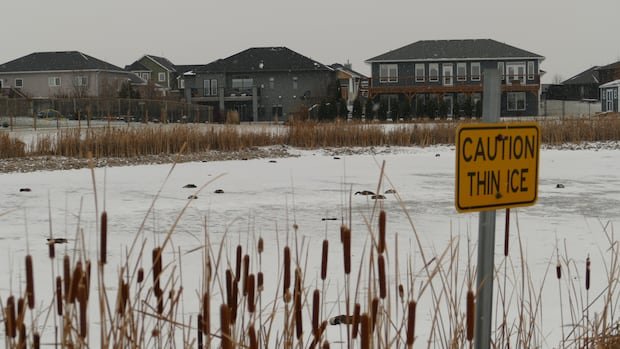
An individual residing in Niverville was taken aback to witness numerous deceased geese on the retention pond in his backyard, with one even found on his back deck.
All the geese succumbed to an outbreak of avian flu.
Mason Goulet observed several Canada geese on the ice, struggling to move, approximately three weeks ago.
“Initially, we thought some of them might have been frozen onto the ice,” Goulet remarked from his porch on Thursday. “As it turned out, they were actually unwell.”

On November 13, the town of Niverville issued a statement informing residents that the Manitoba Conservation Branch had identified avian flu within the local goose population. The virus has been previously detected in nearby communities.
Laboratory tests have verified that it is the H5 avian influenza virus. H5 is present in wild bird populations, with the H5N1 subtype being responsible for certain human cases of the disease.
Goulet was dismayed to find the deceased goose on his porch upon returning from a brief absence. He estimated that it had been there for three to five days.
Conservation authorities instructed him to leave it in place, stating that it could take up to another week before disposal.
Goulet and his neighbors are worried about the well-being of the goose population and the potential for other animals to fall ill. He has observed eagles feeding on the carcasses.
“With people’s dogs roaming around, there’s a risk that they might eat something they shouldn’t,” Goulet expressed.
“Our cat enjoys being on the deck, but we were advised not to touch the goose for now, so we can’t let him outside.”

Frank Baldwin, a biologist with the Canadian Wildlife Service, explained that avian flu is naturally present in waterfowl. He noted that the immunity of a population diminishes over time.
In Manitoba, it is uncommon to observe such elevated mortality rates because the virus typically peaks after the geese have completed their seasonal migration, according to Baldwin.
Similar mortality rates have been reported in other regions of Canada, including southern Ontario, Quebec, and certain northern parts of the United States, coinciding with colder temperatures.
“When birds are densely concentrated, the virus spreads rapidly through the population,” Baldwin stated.
“Additionally, the birds experience stress due to the cold weather, contributing to the mortality observed here.”
Baldwin and wildlife technician Owen Andrushuk visited retention ponds in Niverville on Thursday to strategize the next steps.

The Canadian Wildlife Service collaborated with the provincial government and the Town of Niverville to remove the carcasses.
A total of 165 carcasses, including the goose on the deck, were cleared on Friday, as per