
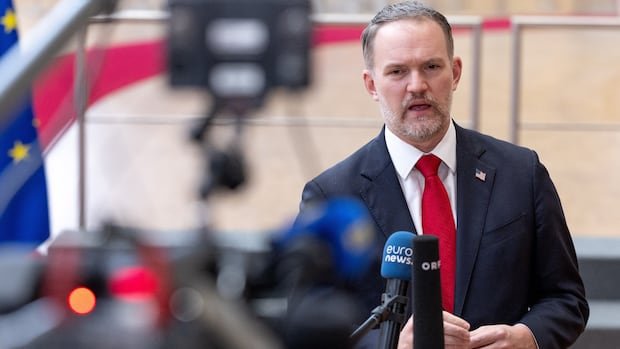

U.S. President Donald Trump’s chief trade negotiator has mentioned the possibility of dismantling the trilateral free trade agreement involving Canada and Mexico, with consideration for pursuing individual agreements instead. U.S. Trade Representative Jamieson Greer indicated on Wednesday that the Trump administration is exploring various options for the future of the Canada-U.S.-Mexico Agreement (CUSMA), set to be reviewed in 2026.
Greer, a key figure in trade talks, highlighted the distinct economic relationships the U.S. holds with Canada and Mexico, pointing out differences in labor dynamics, import-export patterns, and legal frameworks. This rationale supports the notion of engaging in separate discussions with each neighboring country, potentially ending three decades of a unified North American free trade pact.
The deadline for all three nations to declare their stance on extending, renegotiating, or allowing the agreement to lapse is by July 1 next year. Greer is required to submit a report to the U.S. Congress by Jan. 2, signaling the administration’s intentions regarding CUSMA.
During the recent discussion, Greer refrained from indicating the White House’s leaning towards CUSMA’s fate, mentioning possibilities of termination, revision, or renegotiation of the agreement. However, he strongly hinted at the likelihood of pursuing distinct bilateral accords with Canada and Mexico.
Greer’s remarks align with his previous statements to Politico, where he discussed the potential for separate negotiations with the President. The recent public consultations and industry endorsements of CUSMA underscore the agreement’s significance, urging the Trump administration to retain it.
In a Senate subcommittee appearance, Greer emphasized the importance of enhancing CUSMA’s “rules of origin,” particularly addressing concerns about content qualifications for tariff-free access across the three nations. Allegations of misuse of CUSMA’s rules of origin by certain Canadian firms, accused of incorporating low-cost Chinese content in products for U.S. trade advantage, have been raised by U.S. industries.
While Greer hinted at the possibility of a trilateral deal encompassing critical minerals and trade policy alignment, emphasizing the relevance of such topics within a three-party agreement, he did not dismiss the prospect of a comprehensive deal among all three countries.