
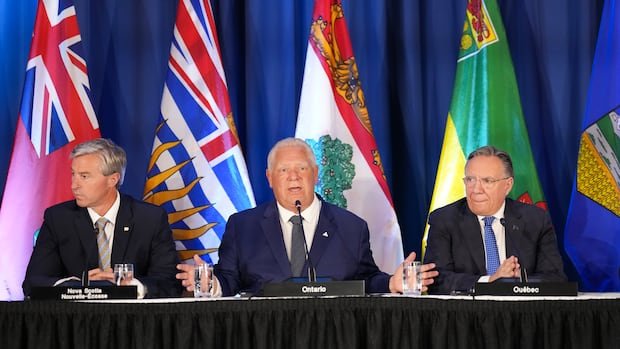

Five premiers are urging Ottawa to retract its recent request for restrictions on the notwithstanding clause, arguing that it disregards the original agreement that led to the Charter of Rights and Freedoms. The notwithstanding clause in the Constitution allows provincial legislatures or Parliament to enact laws that can override certain Charter provisions for a limited period of five years.
Ottawa’s submission to the Supreme Court of Canada in a case concerning Quebec’s secularism law asserts that the notwithstanding clause cannot be used to distort or eliminate the rights and freedoms safeguarded by the Charter due to constitutional limitations. The federal government contends that the temporary nature of the notwithstanding clause prevents it from causing irreversible harm to Charter rights as any such action would be akin to indirectly amending the Constitution, thereby necessitating judicial review.
In a letter addressed to Prime Minister Mark Carney, the premiers of Ontario, Quebec, Alberta, Saskatchewan, and Nova Scotia are urging Ottawa to reconsider its stance and retract its legal arguments immediately. They argue that the federal government’s position introduces new constraints on the authority of democratically elected legislatures to utilize the notwithstanding clause and lacks a solid foundation in the constitutional text.
The premiers express concerns that Ottawa’s arguments pose a threat to national unity by undermining the sovereignty of provincial legislatures, emphasizing the significant implications for Canadian federalism. They assert that the federal government’s position amounts to a direct assault on the core constitutional principles of federalism and democracy.
The ongoing Supreme Court case involves the attorney general of Quebec as the respondent, with several attorneys general from different provinces participating as interveners. Justice Minister Sean Fraser highlighted that the case’s outcome will influence how both federal and provincial governments can employ the notwithstanding clause in the future.
The Ontario government, in its submission to the Supreme Court, underscores the critical role of the notwithstanding clause in Canada’s constitutional democracy, emphasizing that it allows elected representatives to prioritize laws deemed essential for the public interest despite certain Charter provisions. Ontario further states that the notwithstanding clause should not be viewed as a flaw requiring judicial reinterpretation.
Ontario Premier Doug Ford criticized the federal stance, particularly targeting Justice Minister Sean Fraser and Prime Minister Mark Carney. Ford condemned the federal government’s position as disastrous, asserting that legislatures hold supreme authority and should not be overruled by judicial intervention.