
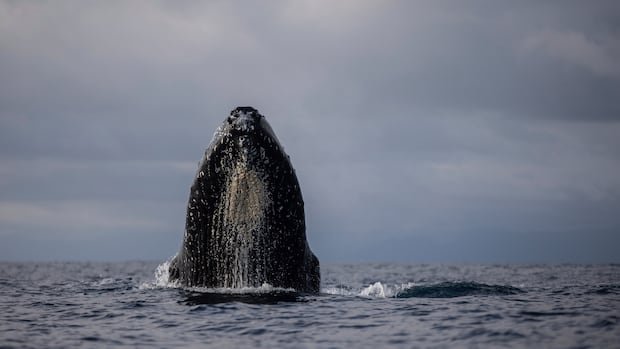

A bioacoustician named Eduardo Mercado was captivated by the mesmerizing sounds of humpback whale songs when he first encountered them. Unlike the prevailing belief among scientists that these songs were primarily mating calls, Mercado speculated that humpbacks might be using their songs for echolocation purposes, akin to dolphins. This curiosity led him to dedicate his career to unraveling the true meaning behind whale songs.
Mercado, a professor at the University of Buffalo, recently published a book titled “Why Whales Sing,” where he delves into his extensive research on the subject. In a discussion with host Bob McDonald on “Quirks & Quarks,” Mercado shared insights into the nature of whale songs and their potential as a form of sonar rather than a means of courtship.
According to Mercado, whale songs differ from traditional human or bird songs in that they lack a distinct start and stop. Humpback whales, a type of baleen whale, can produce continuous sounds for hours, cycling through a fixed sequence of patterns without a clear beginning or end. This continuous cycle resembles an acoustic carousel, maintaining a consistent order.
Contrary to the common belief that whales sing for courtship purposes, Mercado argues that these songs serve as a sophisticated form of echolocation, akin to how bats navigate their surroundings. He observed that the sounds within whale songs undergo changes over time, suggesting a dynamic process of exploration rather than a static display for mating rituals.
While many scientists attribute whale songs to courtship displays due to the presence of male whales during singing activities, Mercado’s research challenges this notion. He noticed significant variations in the sounds used by whales over time, indicating a form of echolocation that allows whales to generate their own internal understanding of their surroundings.
Through his studies on dolphin echolocation and comparisons with other echolocating animals like bats, Mercado gathered evidence supporting his hypothesis that whales use their songs for sonar purposes. His experiments on the physics of echolocation revealed the potential for whales to detect distant objects through sound waves, showcasing the remarkable abilities of these marine mammals.
Overall, Mercado’s research sheds light on the intricate nature of whale songs and their role in echolocation rather than conventional courtship rituals. By exploring the depths of these underwater sounds, he unveils a new perspective on the communication and navigation strategies employed by these majestic creatures.