
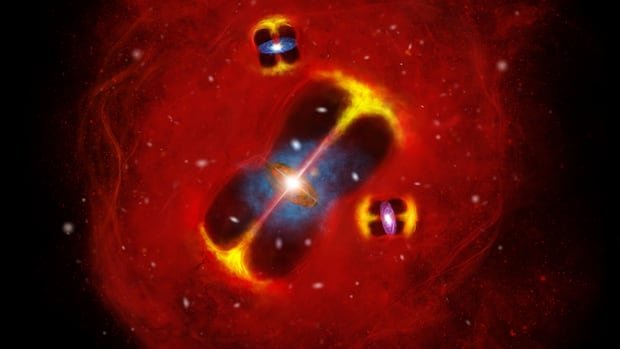

A group of international scientists, spearheaded by an astrophysicist from the University of British Columbia, have uncovered a youthful galaxy cluster emitting hot gas at a rate five times higher than previously believed possible. This finding has sparked enthusiasm among astrophysicists, suggesting a potential shift in the understanding of the early universe post-Big Bang.
The research, featured in the Nature journal, engaged over two dozen researchers globally and focused on the galaxy cluster SPT2349-56 situated approximately 12 billion light years away. Led by UBC PhD candidate Dazhi Zhou, the team identified a substantial amount of hot gas present in the intergalactic space.
Zhou noted that this detection of hot gas at such an early cosmic epoch is groundbreaking, as the galaxy cluster in question, formed only 1.4 billion years following the Big Bang, is considered relatively young. Describing it as a significant leap in comprehending the universe’s workings, Zhou highlighted the study’s pivotal nature.
James Di Francesco, the director of the Dominion Astrophysical Observatory near Victoria, emphasized that prevailing theories did not anticipate galaxy clusters becoming as hot as quickly. Typically, the gas between galaxies is expected to heat up gradually over time due to the energy injected by the galaxies as they orbit.
However, the remarkably early and intense heating of gas within this nascent cluster challenges existing notions. Di Francesco, uninvolved in the study, underlined the revolutionary aspect of this observation, providing fresh insights into cluster evolution contrary to prior expectations.
The researchers’ identification of a substantial volume of hot gas, presumed to manifest billions of years post-formation of the SPT2349-56 cluster, was facilitated by telescopic observations in Chile. These observations enabled a deeper exploration of star formation and the universe’s earliest phases, showcasing the gas’s temperature despite its vast distance from Earth.
Utilizing radio telescopes to examine short wavelengths, Zhou elucidated how these instruments accurately captured the gas’s heat levels. This advanced understanding, obtained through innovative observation techniques, will be instrumental in unraveling the mysteries surrounding contemporary massive galaxy clusters and their genesis.