
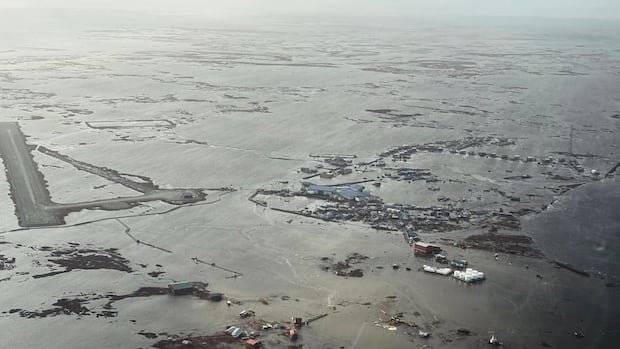

Rain and strong winds were predicted on Wednesday along the Alaskan coast following the havoc caused by Typhoon Halong, with officials working urgently to find accommodations for over 1,500 displaced individuals. The weekend storm unleashed powerful winds and storm surges that severely impacted the low-lying Alaskan Native communities situated along the Yukon-Kuskokwim Delta in the southwest region of the state, nearly 800 kilometers away from Anchorage.
At least one fatality was reported, and two individuals were still unaccounted for. The Coast Guard conducted rescue operations, rescuing two dozen people whose homes were swept away into the sea by the storm.
Many residents were seeking refuge in school shelters, some of which lacked functional toilets, authorities confirmed. This weather disturbance followed a previous storm that hit parts of western Alaska.
Across the affected region, more than 1,500 residents were displaced due to the consecutive storms. Dozens were airlifted to a shelter established in the National Guard armory in Bethel, a city with a population of 6,000, and officials were contemplating transferring evacuees to more permanent shelters or emergency housing in Fairbanks and Anchorage.
The communities most severely impacted included Kipnuk, with a population of 715, and Kwigillingok, with a population of 380. These communities are not accessible via the state’s main road system and can only be reached by water or air during this time of the year.
Mark Roberts, incident commander with the state emergency management division, described the situation in Kipnuk as “catastrophic,” emphasizing the urgent need for support in the devastated community.
One resident, Brea Paul from Kipnuk, recounted the distressing sight of numerous homes floating away under the moonlight during the storm, feeling helpless as they blinked their phone lights, seemingly asking for assistance.
In Kwigillingok, a tragic discovery was made as one woman was found deceased, and the search for two missing men was called off after their home was swept away by floodwaters.
The National Guard was mobilized to assist with emergency response efforts, aiming to deliver essential supplies like food, water, generators, and communication equipment during brief breaks in the challenging weather conditions.
Experts warned of a prolonged recovery process and stressed the necessity for ongoing assistance to the hardest-hit communities. With winter approaching, the need for rebuilding supplies to be transported in a timely manner is crucial, with officials acknowledging the resilience of the indigenous communities in Alaska amidst the challenging circumstances.
Rick Thoman, an Alaska climate specialist at the University of Alaska Fairbanks, highlighted the potential link between the storm’s intensity and warming Pacific Ocean waters due to human-induced climate change, underscoring the need for collective efforts in the face of such natural disasters.
Not long ago, the remnants of Typhoon Merbok caused extensive damage across a significant portion of western Alaska, illustrating the region’s vulnerability to extreme weather events.