
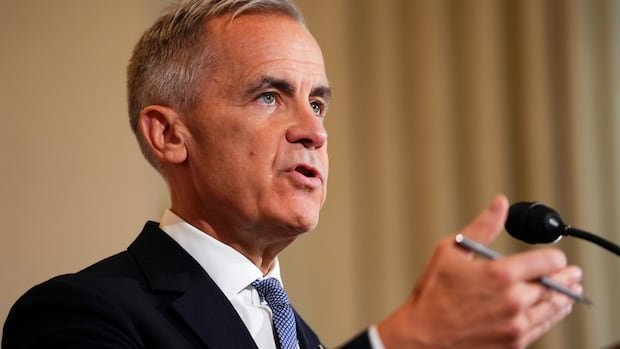

In the recent federal election campaign, Prime Minister Mark Carney expressed his admiration for Quebec musicians Coeur de Pirate and Rock et Belles Oreilles, emphasizing the significance of French in Canadian identity. However, an analysis by Radio-Canada indicates that French has played a lesser role in his speeches since taking office.
Radio-Canada’s examination of Carney’s 59 speeches and press conferences from April 29 to Sept. 14 shows that only about 17% of his speaking time was devoted to French. This percentage drops to 13% during international events.
Comparatively, experts note a decrease in French usage by Carney compared to past prime ministers, with the former Bank of Canada and Bank of England governor consistently favoring English. Official Languages Commissioner Raymond Théberge stresses the importance of bilingualism for the prime minister as a symbol of Canadian identity and linguistic equality.
While Carney’s team is responsible for preparing his speeches and addresses, the proportion of French usage has been a subject of criticism. Former PM Justin Trudeau’s government required a minimum of 20% French at international events, escalating to 30% in English-speaking regions and 80% in Quebec.
Critics, including Conservative leader Pierre Poilievre and Bloc Québécois House leader Christine Normandin, argue for equal representation of both official languages. They highlight the need for Carney to demonstrate linguistic equality, especially in his public statements.
In defense of Carney, Minister of Official Languages Steven Guilbeault mentions the prime minister’s efforts to improve his French skills. Guilbeault highlights Carney’s use of French in private meetings and the presence of French-speaking staff in his office as indicators of progress.
Historically, bilingualism has been a hallmark of Canadian prime ministers, emphasizing the importance of both English and French. While some experts believe Carney’s limited French proficiency may not hinder his ability to connect with voters, others stress the significance of setting a higher standard for linguistic inclusivity.
Moving forward, Carney’s commitment to bilingualism in his public addresses will be closely monitored, with voters and minority communities expecting a strong message that values the French language equally. As the French language holds a vital place in Canadian identity, the prime minister’s language choices will continue to be scrutinized throughout his term.