
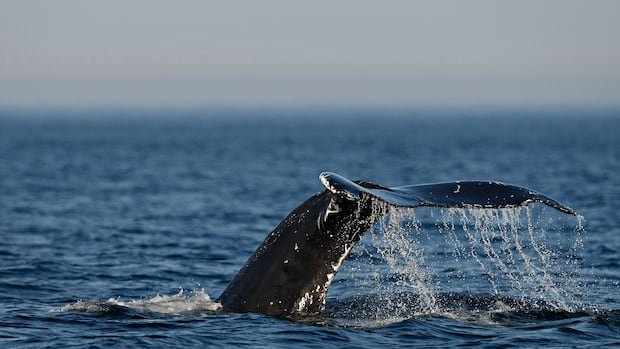

As temperatures rise in the Gulf of St. Lawrence, recent Canadian research indicates a change in the diets of certain baleen whales. According to lead researcher Charlotte Tessier-Larivière from Université du Québec à Rimouski, a decline in Arctic krill, a key prey for fin whales in the 1990s, has led to a shift towards consuming more forage fish like capelin, mackerel, and herring. This dietary adaptation showcases the whales’ ability to adjust to varying prey availability.
The study, conducted over 28 years during the summer months, involved analyzing tissue samples from the whales and their prey for carbon and nitrogen isotopes, providing insights into their feeding patterns. The findings revealed an increase in forage fish consumption across all three whale species in later years, highlighting the significance of these fish in the local ecosystem.
Although the whales were found to be feeding on similar types of fish, there was evidence of “resource partitioning,” suggesting they were targeting different fish species to minimize competition due to limited food resources. This adaptive behavior reflects the intelligence of these marine mammals, as observed by Janie Wray, CEO of BC Whales and North Coast Cetacean Society.
Wray’s recent study on bubble net feeding by humpback whales showcased their sophisticated hunting techniques, including collaboration with fin whales. While the whales may forage in the same area, they exhibit distinct feeding behaviors, possibly targeting different fish species at varying depths.
With changing ocean conditions, whales are evolving their hunting strategies, emphasizing the need to protect critical marine habitats where these animals congregate. By understanding whale behavior and adapting conservation efforts based on climate-informed management, Canada can safeguard whale populations and their marine environments for the future.