
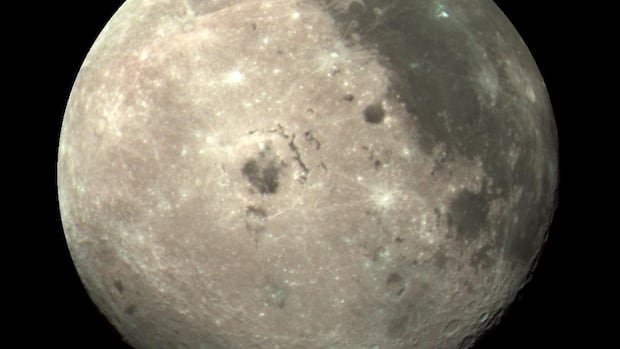

When Jeremy Hansen, a Canadian astronaut, embarks on the Artemis 2 mission beyond the moon, part of his task will involve observing the far side of the moon, which remains unseen from Earth. Simultaneously, scientists on Earth will also be monitoring closely as they plan to send telescopes and robots to explore deep space from that vantage point.
The moon presents two distinct faces due to its gravitational lock with Earth, always showing one side towards our planet and the other side towards outer space. While commonly referred to as the “dark side,” this is a misconception, as the far side receives as much sunlight as the Earth-facing side.
The far side of the moon features a rugged, crater-filled terrain compared to the near side’s smooth plains known as “Maria,” which translates to seas in Latin. This side is notably devoid of artificial radio interference from Earth, making it a prime location of interest for astronomers planning to set up radio telescopes.
Exploration of the far side of the moon is exclusive to spacecraft, granting Hansen a rare opportunity to witness sights few humans have seen since the Apollo missions. Unlike the early astronauts who orbited near the equatorial regions, Hansen’s Artemis flight path will take him approximately 7,500 kilometers beyond the moon, offering a unique view of the entire globe and the Earth alongside the moon simultaneously, a perspective never before witnessed by human eyes.
During the Artemis mission’s lunar flyby, the crew will keenly observe the lunar surface through the windows, utilizing the human eye’s capability to discern intricate details such as color variations and surface textures that cameras might overlook. These observations are crucial for assessing ground conditions that could impact future spacecraft landings.
One of the proposed missions for the far side includes the Japanese TSUKUYOMI, a Lunar Meter Wave Telescope project set to establish a radio dish array on the lunar far side. This initiative aims to delve into the universe’s early days during the “dark ages,” approximately 400,000 years post big bang, where neutral hydrogen gas prevailed, emitting faint radio signals detectable by sensitive instruments on the moon.
Moreover, insights from the dark age signals could unravel mysteries surrounding dark matter’s influence on the early universe’s evolution, potentially shaping the emergence of stars, galaxies, and planets.
The TSUKUYOMI prototype is slated to land near the moon’s south pole in 2027-2028, followed by additional antennae installations on the far side in the 2030s. Other forthcoming initiatives include the LuSEE Night from the University of Boulder Colorado and the Farside Seismic Suite by NASA, aimed at recording moonquakes and enhancing lunar observations.
Furthermore, both NASA and ESA have early-stage plans for lunar observatories, while human missions to the moon prioritize establishing colonies and investigating water ice at the south pole, ensuring constant Earth visibility for communication purposes from the landing sites.
As human missions advance on one side of the moon, a host of robots on the far side will quietly explore the universe’s limits, endeavoring to unveil the secrets of the cosmos and the origins of existence.