
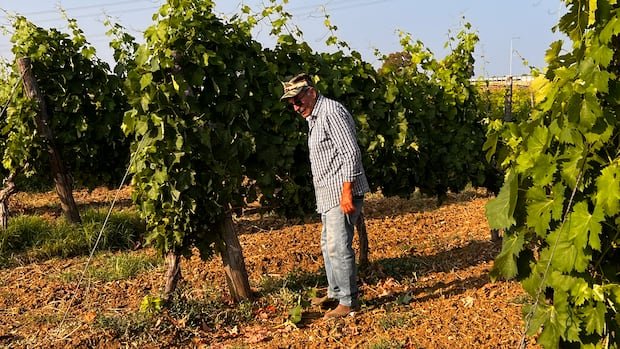

Massimo Tosoni strolls among his vineyards, where the rows extend like green ribbons under a relentless sun. In the background, the town of Tarquinia perches on a hill once dominated by the ancient Etruscans.
“The rows of vineyards over there,” he points while indicating a local red grape, Ciliegiolo, prized for its cherry-like scent. “The soil is as dry and hard as stone.”
The 73-year-old shakes his head, observing the consequence of soil left unwatered for too long, drained of life by the sun, hindering water reabsorption.
Italy’s vineyards, like those worldwide, are contending with increasingly hot and prolonged summers, erratic weather patterns, and diminishing water resources.
These changes are compelling winemakers to reconsider a fundamental aspect of their trade: terroir, the intricate interplay of soil, sunlight, wind, rain, and human intervention that imparts each wine with its distinct flavor, some might argue, its essence.
If global temperatures escalate by more than 2 degrees Celsius by the end of the century, studies indicate that up to 90 percent of Italy’s lowland and coastal wine regions—approximately one-third of the nation’s wine-growing terrain—could become unsuitable for viticulture, with similar threats looming over most vineyards worldwide.
Italy, a leading global wine producer with a sector valued at $20.7 billion Cdn, constituting 10 percent of the country’s agri-food economy, faced record exports of $12 billion Cdn in 2024 before U.S. President Donald Trump’s tariffs on the European Union. This growth was driven by premium and certified wines, despite producers contending with extreme climate events like drought in the south and hailstorms and heavy rainfall in the north.
In northern Lazio, the region surrounding Rome responsible for about three percent of Italy’s wine output, Massimo Tosoni and his daughter, Martina Tosoni, 42, who returned to the family farm after a stint in tourism in Spain, are among the multitude of producers already adapting to the changing climate.
Their white grape varieties, Trebbiano, Malvasia, Vermentino, and Vioner, historically harvested in October, now mature by late August.
“Last year, we delayed too long, resulting in a third of our harvest being lost due to climate change,” Massimo lamented.
Nearby producers have started replacing local Sangiovese and Montepulciano red grapes with the heat-resistant Syrah, previously predominant on the southern island of Sicily.
Martina emphasized that the scarcity of water, rather than heat, poses the most significant threat now.
“There’s a significant shift in awareness across generations regarding the efficient utilization of water,” she noted.
She and other producers have introduced irrigation rotations to avert shortages and upgraded their systems to minimize wastage. Younger growers like Martina may also leverage technological solutions and access government grants to address irrigation and other climate-related challenges more effectively.
An age-old and mostly abandoned practice of grafting local grapevines onto wild vines is proving remarkably resilient, as noted by her father.
“That row of Trebbiano white grapes is as old as Martina and is thriving,” he remarked.
Martina stresses the importance of community alongside innovation. She and local producers, who already operate a cooperative for fruits, are establishing a consortium for wine to collaborate on marketing and vititourism strategies, crucial for diversification in increasingly challenging circumstances.
Kimberly Nicholas, a sustainability scientist at Lund University in Sweden, who has researched the nexus between wine and climate change for over two decades, underscores that adapting to a shifting climate is now a top priority for every wine producer.
“The most significant change is the universal acknowledgment within the wine industry that this is a reality. It’s not some distant future scenario; it’s happening now,” she emphasized.
Grapes are ripening earlier at higher temperatures, leading to detrimental alterations in the compounds that contribute to the distinctiveness of wines, resulting in reduced acidity, increased sugar content, higher alcohol levels, and a loss of complexity in flavor.
While some excess alcohol can be rectified in the winery, vineyard-based strategies such as shading vineyards with cloths, traditional trellising to provide more foliage for fruit shading, and orienting rows to minimize direct sun exposure are more effective.