
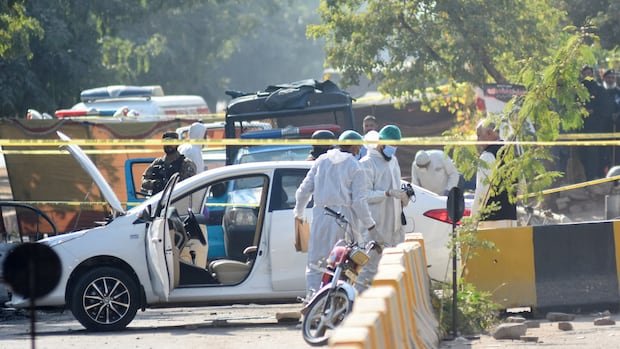

Pakistan’s Minister of Interior reported that a suicide bomber detonated explosives near a police vehicle outside the gate of a district court in Islamabad, the nation’s capital, resulting in the death of 12 individuals and injuring 27 others on Tuesday. The perpetrator attempted to breach the court premises but resorted to targeting a police vehicle, as stated by Mohsin Naqvi, the Minister of Interior. Confirming the incident as a suicide bombing, Naqvi mentioned that the explosion was audible from a considerable distance and occurred during a time when the court vicinity is usually crowded with visitors.
A splinter group of the Pakistani Taliban, known as Jamaat-ul-Ahrar, claimed responsibility for the attack through messages from their leader, Omar Mukaram Khurasani. Contrarily, Sarbakaf Mohmand, a prominent figure within the group, disassociated the organization from the assault. Following the death of Jamaat-ul-Ahrar’s leader in a blast in Afghanistan in 2022, the group separated from the Pakistani Taliban, although some members have rejoined the TTP. The TTP, distinct from but allied with the Afghan Taliban, continues to exhibit internal divisions.
Jamaat-ul-Ahrar’s history of smaller attacks contrasts with the gravity of striking the Pakistani capital, posing challenges for the government amid a resurgent Pakistani Taliban, border tensions, and a fragile ceasefire with Afghanistan. Initial reports from Pakistani state media and security officials suggested a car bomb caused the explosion.
Alleging the involvement of “Indian-backed elements and Afghan Taliban proxies” linked to the Pakistani Taliban, Naqvi expressed suspicions without presenting evidence, emphasizing that authorities are investigating all angles of the incident. In response, Randhir Jaiswal, the official spokesperson of India’s Ministry of External Affairs, dismissed Pakistan’s accusations as groundless.
The attack prompted widespread condemnation from various nations and international bodies, including the United States, China, Saudi Arabia, Qatar, Turkey, and the United Nations. UN Secretary-General Antonio Guterres called for a comprehensive investigation and underscored the accountability of all terrorism perpetrators.
The scene outside the courthouse was chaotic, with police swiftly securing the area as smoke billowed into the air. Most casualties were bystanders or individuals present for court proceedings, according to Islamabad police. Ambulances rushed to aid over a dozen severely injured individuals, while eyewitnesses described the panic and chaos that ensued.
In a separate incident earlier that day, Pakistani security forces thwarted an assault by militants at an army-run college, where a suicide car bomber and five other Pakistani Taliban members targeted the facility in a northwestern province. The clash, which began on Monday evening, resulted in the death of two militants and the containment of three others within the compound.
The TTP disavowed involvement in the college attack, highlighting the group’s emboldenment following the Taliban’s ascension in Kabul in 2021. The surge in militant activities in Pakistan, including the recent assault, underscores the persistent security challenges faced by the nation.
Tensions between Pakistan and Afghanistan have escalated, with Kabul attributing drone strikes in the Afghan capital to Islamabad. Despite ceasefire efforts brokered by Qatar, peace talks between the two nations have faced obstacles, including Kabul’s reluctance to assure that militant factions, such as the TTP, will not exploit Afghan territory against Pakistan. Previous ceasefire attempts between Pakistan and the TTP have faltered, indicating the complex dynamics of regional security.