
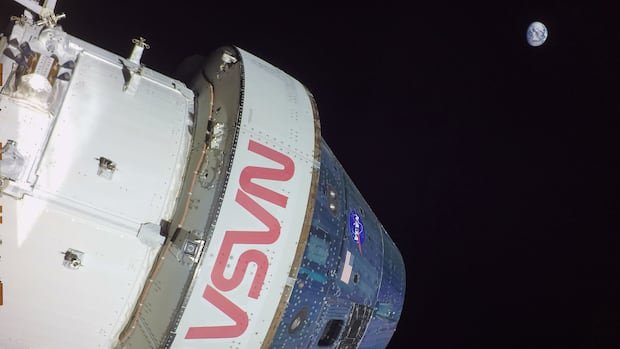

The Artemis II mission is nearing its conclusion, with NASA astronauts Reid Wiseman, Victor Glover, Christina Koch, and Canadian Space Agency astronaut Jeremy Hansen completing an unprecedented journey around the moon aboard their Orion spacecraft named Integrity. They are expected to splash down in the Pacific Ocean off the coast of San Diego, Calif., tonight at 8:07 p.m. ET, after traveling the farthest distance ever by humans.
As they make their way back to Earth, the spacecraft will reach speeds of nearly 40,000 km/h, with the capsule heating up to 3,000 degrees Celsius. This intense re-entry experience will subject the astronauts to almost 4 Gs, making them feel four times heavier than usual, akin to being under immense pressure.
In a recent press briefing, Glover shared his profound thoughts on the fiery descent, emphasizing the lasting impact of the journey. Prior to their return, several critical events must unfold. The European Space Agency’s European Service Module, which has been supplying power to Orion, will detach before re-entry, followed by potential trajectory adjustments and maneuvers to separate from the service module.
As the spacecraft re-enters Earth’s atmosphere, a plasma buildup will disrupt communication with NASA ground control for approximately six minutes. The heat shield, Avcoat, will protect the crew from the intense heat generated during re-entry. Modifications to re-entry procedures were made following the Artemis I mission, where issues with material breakage were identified.
Upon reaching about 1,800 meters, the main parachutes will deploy to slow the spacecraft down to 32 km/h for a smooth splashdown off the San Diego coast. The recovery process will involve the USS John P. Murtha ship retrieving the astronauts, who will then be transferred to a raft for medical evaluations before returning to the Johnson Space Center in Houston.
The crew’s scientific findings will also be carefully managed, with immediate data transmission and subsequent collection processes in place. The culmination of this remarkable journey will mark the successful completion of the Artemis II mission.