
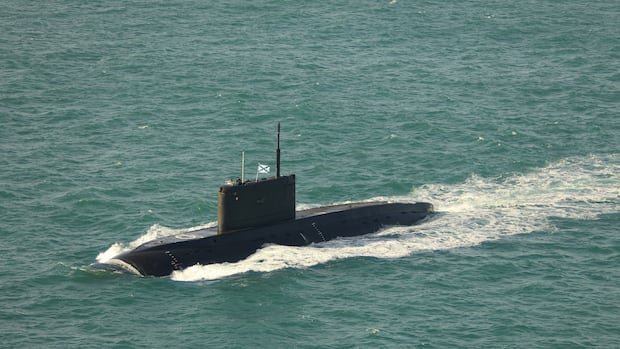

Britain has deployed military vessels to safeguard cables and pipelines from potential attacks by Russian submarines that were present in British waters for over a month earlier this year, announced Defence Minister John Healey on Thursday. Healey accused Russia of exploiting the turmoil in the Middle East to carry out a covert operation in the High North maritime region, which houses crucial shipping routes and infrastructure like undersea cables.
Healey disclosed that British forces, along with allies such as Norway, monitored and deterred suspicious activities by the Russian submarines. He confirmed that the submarines have since departed the area without causing any damage to the underwater infrastructure. During a news conference, Healey stated that the operation was made public to signal to Russian President Vladimir Putin that their actions had been detected.
Addressing Putin directly, Healey emphasized, “We are aware of your activities near our cables and pipelines, and any attempt to harm them will not be tolerated and will result in severe consequences.” He highlighted that the armed forces made it clear to the Russian vessels that they were under surveillance, thus thwarting their secretive mission.
The Russian embassy in London dismissed Healey’s remarks as “impossible to believe or verify,” asserting that Russia does not pose a threat to the UK’s undersea infrastructure or employ aggressive language regarding such matters. Moscow has consistently denied any involvement in incidents where European countries’ cables were damaged.
Healey detailed that the Russian operation involved an Akula-class attack submarine and two specialized submarines from Moscow’s Main Directorate for Deep-Sea Research (GUGI). These submarines are purportedly used for surveying underwater infrastructure during peacetime and potentially sabotaging it during conflicts.
Upon detecting the Russian vessels entering international waters, Britain dispatched a frigate, a support tanker, and a maritime patrol aircraft to monitor their movements. Norway’s defense ministry also confirmed the deployment of a P-8 maritime patrol aircraft and a frigate in response to the situation.
Although the Russian submarines did not breach Britain’s territorial waters, they were within the broader sea area surrounding the country, known as its “Exclusive Economic Zone,” as well as the waters of British allies. Healey referenced recent criticisms of Britain’s naval capabilities, particularly following comments by former U.S. President Donald Trump regarding the country’s aircraft carriers.
In light of increased threats and demands on defense, Healey emphasized the importance of deploying military resources effectively. NATO allies have bolstered their presence in the North Atlantic and the Baltic Sea following multiple outages of power cables, telecom networks, and gas pipelines since Russia’s invasion of Ukraine in 2022, with many incidents attributed to civilian ships inadvertently disrupting the infrastructure.