
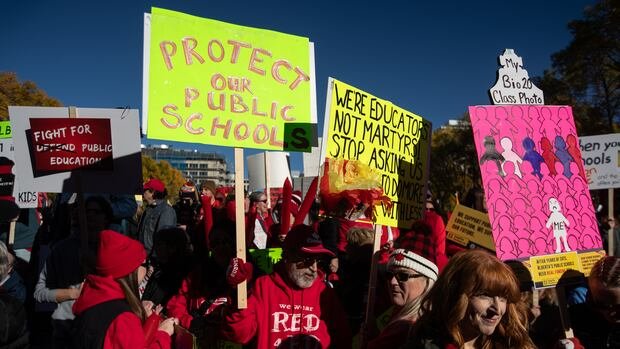

Education Minister Demetrios Nicolaides of Alberta has stated that the government is committed to a $2.6 billion budget over four years to address the ongoing contract dispute with striking teachers. Nicolaides emphasized the importance of working within this financial limit to provide teachers with wage increases and address classroom complexities. A recent vote by nearly 90% of Alberta Teachers’ Association (ATA) members rejected a contract that would involve an additional $2.6 billion expenditure from 2024 to 2028.
The proposed contract included a 12% general wage hike, along with a plan to merge salary grids in 2026, potentially resulting in up to a 5% wage increase for certain teachers. Furthermore, the offer encompassed a commitment from the government to cover the costs of adding 3,000 new teaching positions and 1,500 educational assistants in schools. Subsequently, 51,000 teachers initiated a strike, leading to the closure of approximately 2,000 public, Catholic, and francophone schools across the province.
The Teachers’ Employer Bargaining Association, representing the government and school boards, announced a lockout for teachers effective Thursday afternoon. Minister Nicolaides expressed willingness to consider the ATA’s suggestions regarding the required number of teachers to improve classroom conditions but highlighted the need for trade-offs if additional positions were to be funded beyond the stated 3,000.
Despite two rejections by teachers of the 12% salary increase offer, citing concerns about inflation and increased workloads, ATA President Jason Schilling indicated a need for at least 5,000 additional teachers to meet class-size recommendations outlined in a 2003 Alberta Commission on Learning report. The report emphasized the positive impact of smaller class sizes, particularly for younger students and those from disadvantaged backgrounds.
While acknowledging the importance of class size, Minister Nicolaides questioned the effectiveness of class-size caps on academic performance, stating a focus on building more schools, hiring additional teachers, and addressing classroom conditions. In response, the ATA stressed the significance of student-teacher ratios for student success and advocated for establishing formal ratios to ensure quality learning environments.
Opposition voices, including NDP education critic Amanda Chapman, criticized the government for underfunding schools over the years, leading to inadequate staffing to support diverse student needs. Chapman highlighted the necessity of additional funding to hire more teachers, educational assistants, and mental health professionals to address the growing complexities in classrooms.
The discussion around class sizes and educational quality continues, with experts and stakeholders weighing in on the impact of class sizes on student learning experiences and the broader goals of public education beyond academic achievement.