
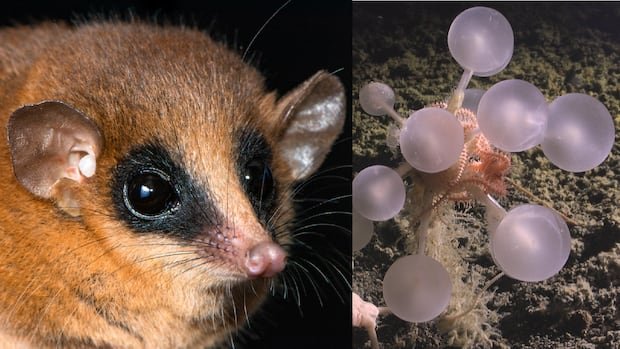

In 2025, a variety of fascinating new species were unveiled by the scientific community. Among these discoveries were a spider species with remarkably elongated genitalia, a carnivorous caterpillar that adorns itself with prey body parts, and a diminutive opossum residing in mountainous regions.
Research indicates that approximately 16,000 novel species are identified annually, with the pace of discovery accelerating. Notably, 15% of known species have been newly documented in the past two decades. This trend far surpasses the rate of species extinctions, estimated at around 10 per year.
While some newly described species were previously known or documented locally, the scientific identification and description process play a crucial role. John Wiens, an ecology professor at the University of Arizona, emphasized the significance of officially recognizing these species, stating that conservation efforts rely on acknowledging their existence.
Exploring some of the standout discoveries, four tarantula species with males possessing exceptionally lengthy genitalia were found in the Horn of Africa and Arabian Peninsula. The largest species, Satyrex ferox, boasts a leg span of 14 centimeters, with males possessing palps measuring up to five centimeters in length.
In Hawaii, scientists encountered a unique caterpillar species dubbed the “bone collector,” which constructs a coat using body parts of prey it consumes while residing in spider webs. This caterpillar, found in a limited forest area on O’ahu, is considered endangered.
Venturing into the deep Southern Ocean near Antarctica, researchers unearthed 30 new species, including the carnivorous “death-ball” sponge, which captures prey using tiny hooked spheres. Additionally, new sea star species and an iridescent scale worm were identified in this region.
Shallower waters revealed a sea slug named Phyllidia ovata that resembles fried eggs and steals toxins from sponges for protection. This visually striking slug, previously sighted in Indonesia, was formally described in July.
In Canada, the Okanagan crayfish, a freshwater species in B.C.’s Okanagan Lake, was identified as a distinct species due to the absence of a distinct white marking found in a similar species. Concerns arise for the Okanagan crayfish’s conservation status due to its potential endangerment.
Canadian researchers contributed to the discovery of six new tube-nosed bat species from the Philippines, weighing between four to 14 grams each. These bats were collected over several decades and described in a recent study.
Lastly, a small mouse opossum species named Marmosa chachapoya was found in the Peruvian Andes, characterized by its diminutive size and unique habitat. The species, described in the American Museum Novitiates, thrives at higher elevations compared to other mouse opossums.
In Tanzania’s Eastern Arc Mountains, tree-dwelling toads were identified that give birth to live toadlets, skipping the tadpole stage. This reproductive rarity adds to the intrigue of these newfound species, with some already classified as critically endangered.
The continuous unveiling of new species not only enriches scientific knowledge but also underscores the importance of conservation efforts to protect Earth’s biodiversity.