
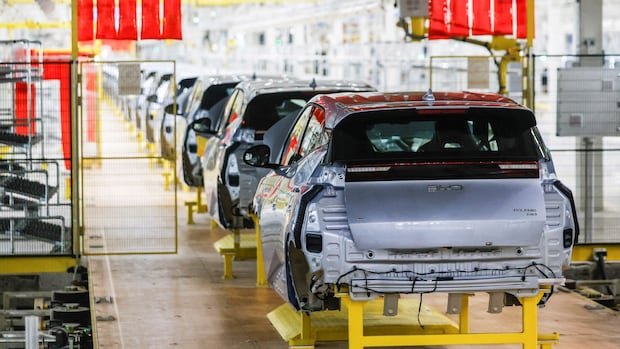

The Canadian market for electric vehicles from China officially opened on March 1. However, popular Chinese brands like BYD and Chery may not be immediately available on Canadian roads. Industry experts suggest that well-known brands like Polestar, Volvo, and Tesla are likely to enter the Canadian market first.
Chinese electric vehicles, such as BYD, Chery, and Geely, are generally priced lower due to cost-effective materials, minimal labor expenses, and government subsidies from China. Despite this, established non-Chinese brands like Volvo, Polestar, and Tesla also produce in China and could benefit from the recent EV agreement announced by Prime Minister Mark Carney in January.
In 2024, China manufactured 12.4 million EVs and aims to achieve annual global sales of 40 million vehicles in the coming years. With an annual cap of 49,000 Chinese-made EVs allowed into Canada at a 6.1% tariff rate, Chinese automakers must strategically select which models to export to maximize profits.
Addisu Lashitew, an associate professor at McMaster University, mentioned that Teslas, Polestars, and Volvos might arrive in Canada soon, while the permitting process could be lengthier for Chinese brands. Streamlining procedures could be beneficial for Canada to prevent reciprocal delays from China affecting market access for products like canola.
The approval process for Chinese-made vehicles intended for sale in Canada involves compliance with the Motor Vehicle Safety Act and Canada Motor Vehicle Safety Standards. Automakers must register with Transport Canada’s Appendix G Pre-clearance Program after meeting regulatory requirements. This program aims to enhance border processes for Canadian importers by registering foreign manufacturers certifying vehicle compliance with Canadian standards.
Inspections for compliance include checks on lighting, brakes, and other components, a process that could take several weeks or months. BYD is the only Chinese EV brand currently cleared under this program due to prior applications for selling taxis and buses in Canada. Transport Canada did not provide details on the approval timeline for imported vehicles, and neither did Global Affairs, which did not respond to inquiries by the deadline.
Despite outreach, Chinese auto manufacturers like Chery and Xiaomi did not disclose if they had submitted approval applications. While Tesla did not comment, a Polestar spokesperson mentioned ongoing evaluations of the market developments.