
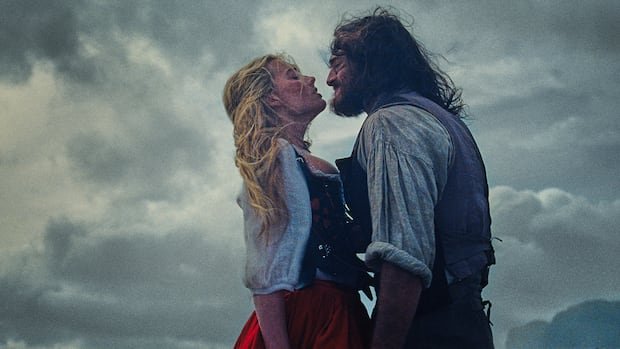

Emerald Fennell’s film adaptation of Emily Brontë’s “Wuthering Heights” is making waves with its unique approach. The title itself, with quotation marks, is a deliberate stylistic choice to emphasize that this is not a typical adaptation but a reimagined memory of the director’s teenage experience with the novel.
The movie portrays the doomed love story between Heathcliff (Jacob Elordi), a brooding orphan, and Catherine (Margot Robbie), the daughter of an estate master, in a dreamlike and visually stunning manner. However, the changes made to the original source material seem to miss the mark in reinventing the story for a modern audience.
One notable deviation is the casting of Elordi as Heathcliff, which has raised eyebrows due to the character’s description in the book as having a non-typical white appearance. This artistic choice by Fennell has sparked discussions about the interpretation of the character’s background and social positioning.
The film’s narrative shifts further diverge from the original novel, particularly in its focus on the intense love story between Heathcliff and Catherine, overshadowing other crucial elements of the plot. While adaptations often take creative liberties, Fennell’s version seems to stray too far from Brontë’s intended themes of social hierarchy and mortality.
Ultimately, Fennell’s rendition of “Wuthering Heights” comes across as a reimagined love story, veering towards a romanticized portrayal that differs significantly from the novel’s dark and complex themes. The film’s stylized aesthetic may be intriguing, but its departure from the original essence of the story raises questions about its effectiveness as a cinematic adaptation.