
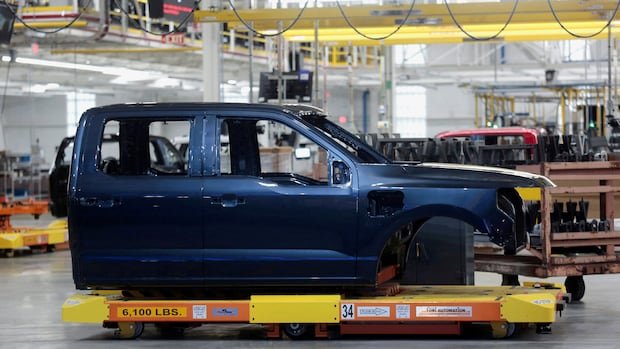

Ford Motor announced a $19.5 billion US writedown and the discontinuation of several electric-vehicle models, marking a significant shift away from battery-powered vehicles in response to changing market conditions influenced by government policies and declining demand for electric vehicles. The company revealed plans to replace the fully electric F-150 Lightning with a new extended-range electric model that utilizes a gas-powered engine for battery recharging. Additionally, Ford is scrapping a next-generation electric truck, known as the T3, and electric commercial vans.
Ford’s CEO, Jim Farley, explained that recent market shifts prompted the company’s decision to alter its strategy towards gas and hybrid models, despite facing some layoffs at a jointly owned Kentucky battery plant in the short term. Ford aims to increase its global mix of hybrids, extended-range EVs, and pure EVs to 50% by 2030, up from the current 17%.
The company plans to distribute the writedown over the coming years, with a significant portion related to the cancellation of planned EV models. Other expenses include dissolving a battery joint venture with SK On from South Korea and program-related costs. Ford also raised its 2025 adjusted earnings before interest and taxes guidance to approximately $7 billion.
The shift in Ford’s strategy reflects a broader trend in the auto industry, with many companies pivoting back to gas and hybrid models due to diminishing demand for electric vehicles following changes in government policies. U.S. sales of electric vehicles dropped around 40% in November after the expiration of a consumer tax credit, leading to a shift towards gas-powered cars. Ford’s decision to discontinue its second-generation EV models underscores its focus on developing more affordable EV models, with plans to introduce the first model at around $30,000 US by 2027.
In light of these developments, industry analysts suggest that traditional automakers may lose market share to pure-play EV manufacturers like Tesla and Rivian. General Motors and Stellantis have also adjusted their EV plans, emphasizing hybrids over electric models. Ford’s move towards profitability in its EV business by 2029 comes amid disruptions in its EV production facilities following the end of its partnership with SK On, leading to changes in ownership and operation of battery plants in Kentucky and Tennessee.