
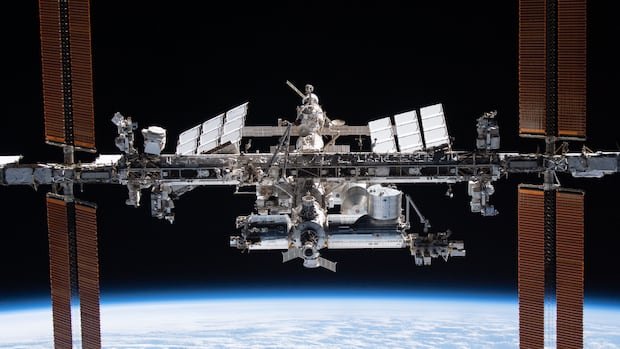

Historical structures, like the residence of Alexander Graham Bell in Nova Scotia, often transition into museums or national historic locations to safeguard their legacy for future generations. But how does one conserve a structure as vast as a football field, orbiting 400 kilometers above Earth?
NASA’s official strategy entails deorbiting the International Space Station (ISS) towards the end of its lifespan, leading to a controlled descent back into Earth’s atmosphere for a crash landing in a remote oceanic area. However, recent legislative developments in the U.S. government urge NASA to reassess this approach and explore the possibility of maintaining the ISS in a low Earth orbit instead.
Since 2000, the ISS has been continuously occupied by numerous astronauts from the U.S., Russia, Canada, Europe, and Japan. Assembled through multiple space shuttle and rocket launches, the ISS, with a mass exceeding 400 metric tonnes, stands as the largest scientific laboratory ever sent into space, facilitating a wide array of experiments unique to microgravity environments.
With its operational lifespan drawing to a close, NASA disclosed in January 2022 that the space station will be decommissioned by 2030 and deorbited in 2031. The current plan involves SpaceX propelling the ISS into a descent through Earth’s atmosphere, resulting in its incineration over a remote Pacific region, akin to the fate of its precursor, the Russian Space Station MIR.
Yet, there are dissenting voices. Former NASA chief of staff, U.S. Rep. George Whitesides, presented a proposal to reconsider the fate of the ISS before committing it to destruction. The proposal, backed with bipartisan support, aims to investigate alternative options for the space station’s future use or preservation.
Despite the proposal, preserving the ISS poses significant challenges. The station cannot be left unattended for extended periods due to atmospheric drag gradually pulling it out of orbit. Moreover, boosting it to a higher orbit would require substantial fuel and pose collision risks with space debris, potentially rendering low Earth orbit inaccessible for centuries.
Efforts to solicit private sector interest in taking over the ISS yielded no viable proposals, underscoring the challenges of maintaining the aging complex. As NASA shifts focus towards lunar and Martian missions, the fate of the ISS remains uncertain, with the likelihood of its fiery demise looming large unless innovative solutions emerge.
While Rep. Whitesides’ proposal navigates through legislative processes, the fate of the ISS as a heritage site remains unclear, with its ultimate fate likely culminating in a controlled descent into Earth’s atmosphere, symbolizing the end of a remarkable era in space exploration.