
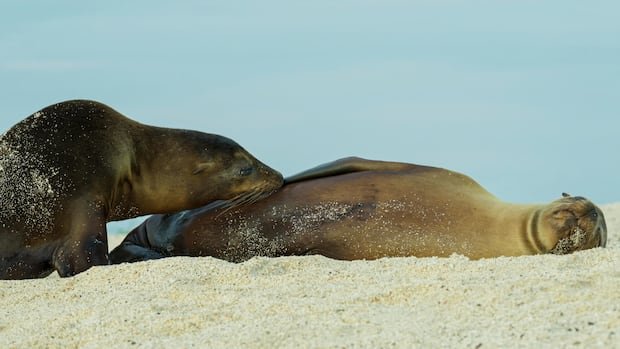

A comprehensive study led by researcher Alexandra Childs sheds light on an intriguing phenomenon observed among fully grown Galápagos Islands sea lions. These sea lions continue to nurse from their mothers well into adulthood, a behavior dubbed “supersuckling.” Childs, a PhD candidate in behavioral and marine biology at the University of Bielefeld in Germany, expressed astonishment at this behavior, likening it to humans breastfeeding into their teenage and young adult years.
The research, recently published in the American Naturalist journal, revealed that approximately 11% of the sea lion population in the Galápagos exhibited supersuckling behavior. While most sea lions weaned from their mothers between 1.5 and 4.5 years of age, the supersucklers defied this norm by continuing to nurse beyond that threshold.
Childs highlighted an instance of a 16-year-old sea lion observed nursing, emphasizing the rarity of such occurrences. Some sea lions engaged in what was termed “multigenerational suckling trains,” where multiple generations of sea lions nursed in succession, forming a unique group dynamic.
Although similar behavior has been noted in other sea lion and seal species, the extent of supersuckling in the Galápagos sea lions stands out. Andrew Trites, director of the Marine Mammal Research Unit at the University of British Columbia, explained that this behavior is more pronounced in the Galápagos due to potentially different environmental factors affecting food availability.
While the study suggests that supersuckling may be a bonding behavior influenced by food availability, further research is needed to ascertain the exact reasons behind this phenomenon. Childs pointed out other potential explanations, such as immunological benefits or social bonding, that warrant exploration in future studies.
As researchers continue to delve into this intriguing behavior, the study underscores the need for ongoing investigation to unravel the mysteries surrounding supersuckling in Galápagos sea lions.