
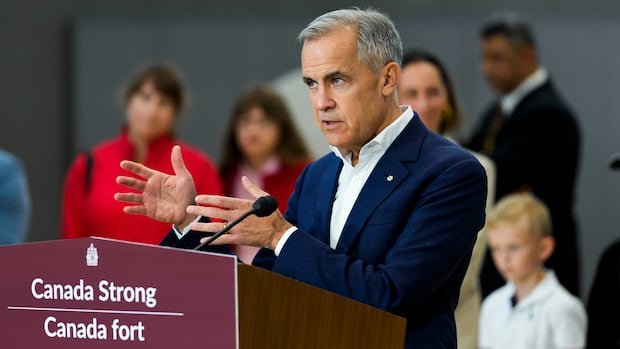

Prime Minister Mark Carney indicated on Friday that the future of the emissions cap on oil and gas producers hinges on broader efforts to reduce emissions, suggesting a potential willingness to discard the policy — a departure from his prior commitment earlier this year. Speaking in Ottawa, Carney responded to queries about the possibility of scrapping the cap and the tanker ban along the B.C. coast, measures that the oil and gas industry and the Alberta government have called for Ottawa to revoke.
“It depends,” Carney stated, before delving into an explanation of his government’s objective to decrease emissions from the energy, mining, and manufacturing sectors to enhance their global competitiveness. “In order to fulfill all those conditions, it depends on what actions are taken. This government prioritizes outcomes over goals,” Carney emphasized.
In March, Carney informed reporters that he intended to uphold the emissions cap, while also expressing a desire to explore alternative methods to decrease emissions. The emissions cap, scheduled to come into effect in 2030, mandates that upstream oil and gas operations lower their emissions to 35 percent below the 2019 levels. Ottawa introduced draft regulations last year, delayed by two years.
As part of its commitment under the Paris climate accord, Canada aims to reduce emissions by at least 40 percent below the 2005 levels by 2030. Carney and his ministers have avoided addressing this specific target, instead emphasizing Canada’s aspiration to achieve net-zero emissions by 2050. The emissions cap forms a crucial component of Canada’s strategy to meet these targets, with the oil and gas sector responsible for approximately 30 percent of total greenhouse gas emissions. Last year, this sector experienced a 1.9 percent increase in emissions, offsetting reductions in other sectors, as highlighted in a report by the Canadian Climate Institute in September.
Carney disclosed ongoing discussions with Alberta Premier Danielle Smith focused on a potential “grand bargain.” This agreement would link Alberta’s desire for a pipeline to the British Columbia coast with the completion of the Pathways Alliance carbon capture project. Smith aims to have a proposal ready for submission to the Major Projects Office by spring, with the hope of finalizing a deal by mid-November.
Regarding support for a new pipeline to the West Coast, Carney emphasized the government’s endorsement of nation-building projects, including traditional energy projects. However, he underscored that such projects must deliver substantial economic advantages, align with climate objectives, and offer benefits to Indigenous communities for the government to consider them.
Smith and industry leaders have iterated that no pipeline project holds merit as long as the emissions cap and tanker ban remain in place. Enbridge CEO Greg Ebel emphasized the industry’s reluctance to construct a pipeline for oil exports off the B.C. coast due to the tanker ban. Tensions have escalated between Smith and B.C.’s NDP Premier David Eby, with Eby cautioning against jeopardizing the current consensus on resource development by repealing the tanker ban.
In addressing potential future pipeline projects, Energy and Natural Resources Minister Tim Hodgson emphasized the need for support from the jurisdiction in which a project is planned. Hodgson highlighted the requirement for Alberta to secure B.C.’s support for any pipeline construction. Carney recently proposed reviving the Keystone XL pipeline during a meeting with U.S. President Donald Trump, suggesting its revival in exchange for relief for Canada’s steel and aluminum sectors.
Critics have raised concerns that even the Keystone XL plan could face obstacles if the government remains steadfast on the emissions cap. Conservative MP Andrew Scheer emphasized the futility of building a pipeline without the ability to transport goods through it.