


A seasoned Mexican legislator predicts the demise of trilateral trade pacts involving Mexico, Canada, and the U.S.
Deputy Germán Martínez Cázares, a former member of the ruling National Regeneration Movement (Morena) party, foresees that the current agreement will not withstand the pressures of nationalism advocated by the present U.S. and Mexican administrations.
Speaking during a session of Mexico’s lower house, known as the Chamber of Deputies, Martínez Cázares stated, “We are moving towards bilateral agreements between Mexico and Canada, and between Mexico and the United States.”
He added, “We are venturing into uncharted territory.”
Despite Mexico’s official stance favoring the continuation of trilateral trade, there is a growing belief in the country’s discourse that the U.S. is hinting at a shift in direction.
Shortly after Martínez Cazares’ remarks to CBC News, U.S. President Donald Trump, accompanied by Prime Minister Mark Carney in the Oval Office, expressed openness to negotiating “different deals” with “individual countries” when questioned about the current trilateral trade agreement.
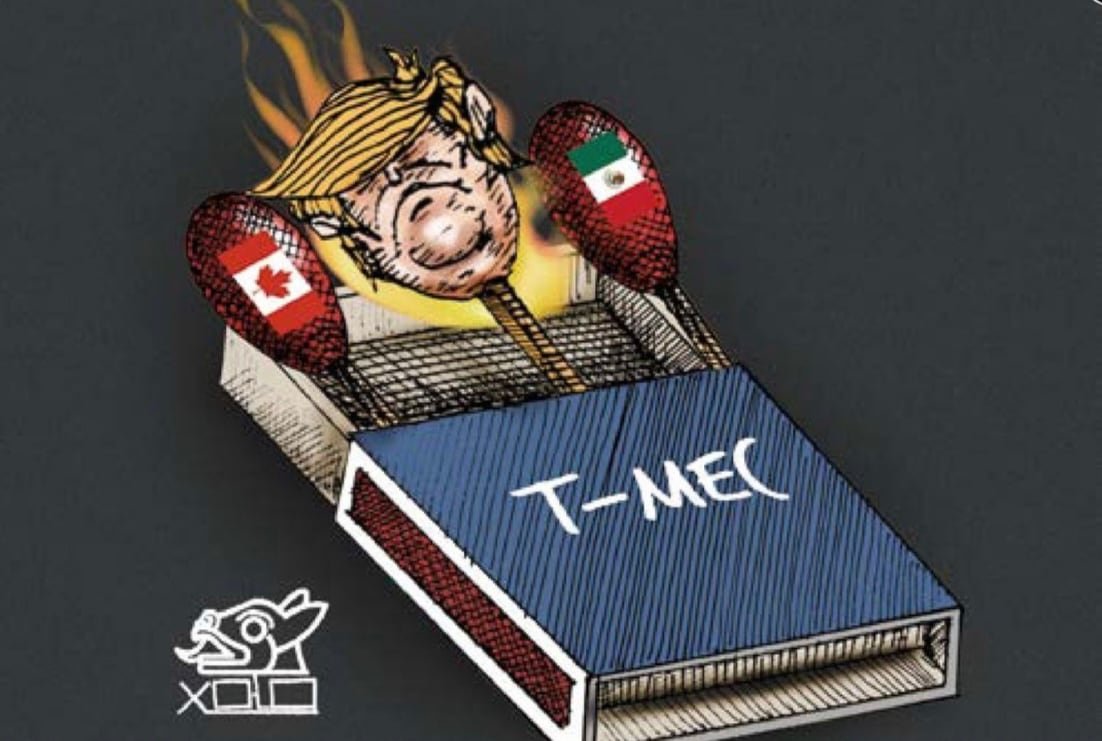
Trump’s comments made headlines in at least three Mexican newspapers on Wednesday, with variations of titles suggesting Trump’s threat to terminate the deal, known as the Canada-U.S.-Mexico Agreement (CUSMA) in Canada and the Tratado entre México, Estados Unidos y Canadá (T-MEC) in Mexico.
Trump’s statements followed remarks from U.S. Trade Representative Jamieson Greer, who recently questioned the value of the deal by highlighting the distinct U.S. relationships with Canada and Mexico. Greer raised doubts about the bundling of these relationships into one agreement.
Addressing the situation, President Sheinbaum emphasized the possibility of bilateral talks within the existing trilateral trade agreement, stating, “Important engagements exist between Mexico and the U.S., the U.S. and Canada, and between Canada and Mexico. Not all meetings have to be trilateral,” she remarked.
NAFTA Fosters Investment
Mexico’s Secretary of Foreign Affairs Juan Ramón de la Fuente Ramírez faced a barrage of questions from the media as he arrived for a senate hearing, reaffirming the government’s commitment to seeing CUSMA through the 2026 review process. He referenced Prime Minister Carney’s support for the agreement during his visit to Mexico in September to strengthen bilateral relations with Sheinbaum.

According to Canadian government data, Mexico stood as Canada’s third-largest trading partner in 2024, following the U.S. and China, with Canada ranking as Mexico’s fifth largest trading ally. The bilateral trade between the two countries surged to $56 billion in 2024 from under $5 billion in the pre-NAFTA era of 1994, showcasing significant growth.
Mexico’s pivotal role in the automotive industry’s supply chain involves exporting vehicles and parts across U.S. and Canadian borders. With over 60 Canadian car part companies operating in Mexico, approximately 30,000 Mexicans are employed in this sector, as per Canadian statistics.
Under CUSMA, Mexico exports various products like machinery, medical equipment, and produce such as tomatoes, avocados, and guavas to Canada, while Canada reciprocates with exports like propane