
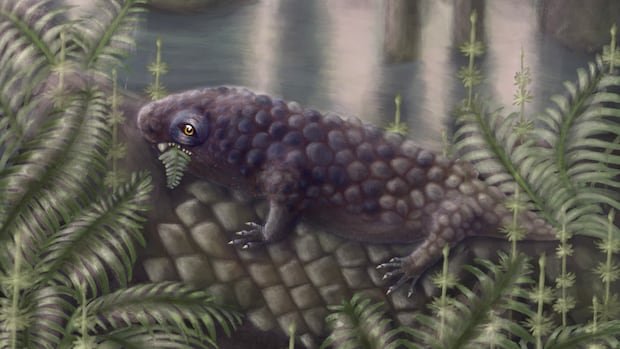

A recently unearthed creature, about the size of a football, exhibited herbivorous behavior long before it was common among vertebrates. This unique animal, named Tyrannoroter heberti, roamed the Earth approximately 307 million years ago in a lush, fern-filled swamp on Cape Breton Island, Nova Scotia. During this period, most tetrapods primarily consumed other animals as they had not yet developed the ability to consume and digest plant matter.
According to a recent study published in Nature Ecology and Evolution, Tyrannoroter heberti is considered one of the earliest four-legged creatures equipped with teeth suitable for a plant-based diet. This discovery challenges previous beliefs about the speed of this dietary transition, as stated by Arjan Mann, the lead author of the study.
Belonging to the microsaur group, Tyrannoroter had a skull resembling that of pantylids, a type of microsaur known for its digging adaptations. Despite most pantylids being small, Tyrannoroter stood out due to its larger size, comparable to a football, earning it the name “Tyrannoroter,” meaning “tyrant digger.”
What sets Tyrannoroter apart is its unique dental structure, featuring multiple rows of teeth shaped like Hershey’s kisses. These teeth were specially adapted to consume plant material by providing the necessary surface area for grinding, a trait not commonly seen in animals of that era.
Researchers also found evidence of similar tooth structures in fossils dating back as far as 318 million years, indicating an early specialization in plant-based diets among this group of animals. This revelation sheds light on the evolution of herbivores and their impact on ecosystems.
Robert Reisz, a paleontologist from the University of Toronto Mississauga, commended the study’s contribution to Canadian paleontology and emphasized the importance of further investigating Tyrannoroter’s herbivorous behavior. While the findings suggest a shift in the timeline of herbivorous tetrapods, more research is needed to confirm this hypothesis.
In conclusion, the discovery of Tyrannoroter heberti provides valuable insights into the early evolution of herbivory and highlights the significance of understanding the dietary habits of ancient animals in shaping ecosystems.