
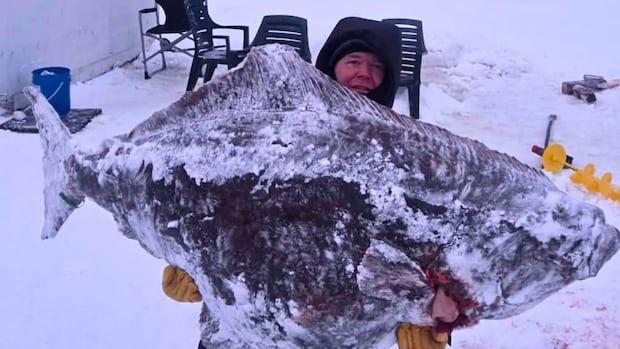

An ice fisherman from Quebec spent two and a half hours battling a 244-pound halibut in the Saguenay Fjord last Saturday, marking the largest Atlantic halibut ever recorded in the area.
Describing the catch as challenging, Marc-André Galbrand, the president of the basin committee, Comité de bassin de la Baie des Ha! Ha! (CBBH), emphasized the need for patience and physical endurance when fishing for such a species.
Measuring two meters long, the halibut surpassed the previous record set last year in the L’Anse-Saint-Jean sector of the fjord. Alain Hamel made the significant catch between Chicoutimi and Tadoussac.
Part of a scientific project in collaboration with the local Fjord Museum, the ice fishing expedition aimed to gather more insights about the species, according to Galbrand.
While fishing Atlantic halibut is prohibited in the Saguenay Fjord, participants in the project catch, tag, and bring the fish for analysis at the museum, where their bones are examined to reveal migration patterns.
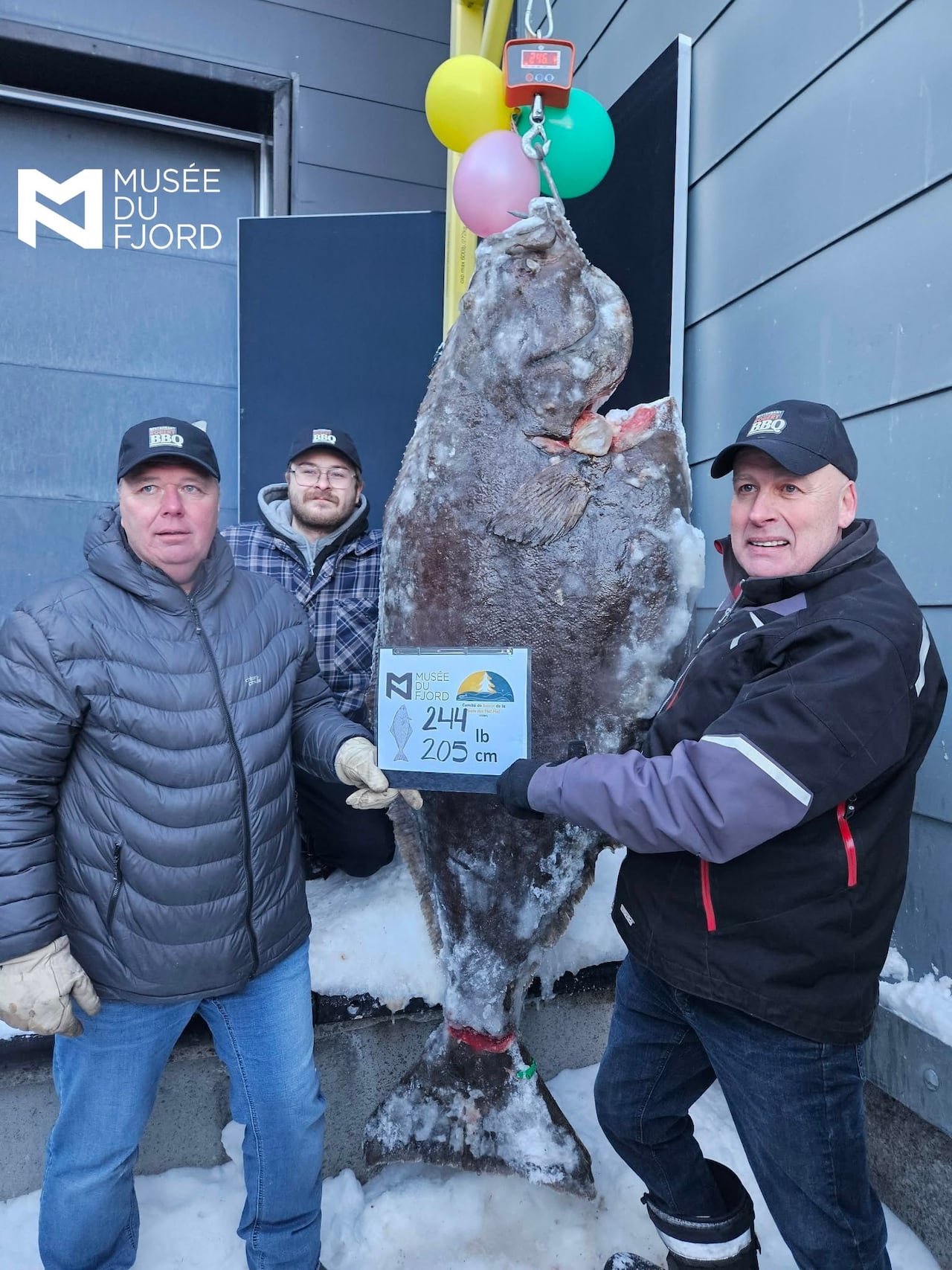
Participants in the project can enjoy the meat from the catch, with an estimated 170 pounds of delicious fish expected from this week’s haul, as mentioned by Galbrand.
Jérôme Rousseau, after four years of involvement in the scientific fishing program and over 1,200 hours of fishing, celebrated his impressive catch of a large Atlantic halibut off the coast of Sainte-Rose-du-Nord on the Saguenay River.
The halibut was taken to the Fjord Museum for further analysis on Monday, where its head and stomach were removed.

Marc-André Galbrand, chairman of the Comité de bassin de la baie des Ha! Ha! (CBBH), discusses the Atlantic halibut fishing season and its premature end with host Alison Brunette, following the record-setting catch of a 244-pound halibut in Saguenay last weekend.
The fisherman plans to enjoy the fish with his fishing companions, considering it a team effort and already exploring recipe ideas.
Depth of water poses challenges
Galbrand views the activity as an “extreme fishing sport” that demands expertise and caution due to the fish’s sharp teeth.
Furthermore, the depth of the water adds complexity, with fishing occurring at depths ranging from 120 to 180 meters.
With the halibuts known for their strength and resistance, Galbrand described the fishing experience as a test of endurance until the fish is finally subdued.
Following the record-breaking catch on Saturday, scientific fishing of Atlantic Halibut was halted in the fjord to avoid exceeding the quota. Out of the 35 authorized halibut under the scientific fishing permit, 27 have been caught so far, with discussions ongoing about allowing a limited number of fishermen to catch the remaining fish through a lottery system, similar to regulations in restricted zones for other species like salmon or moose.
</