
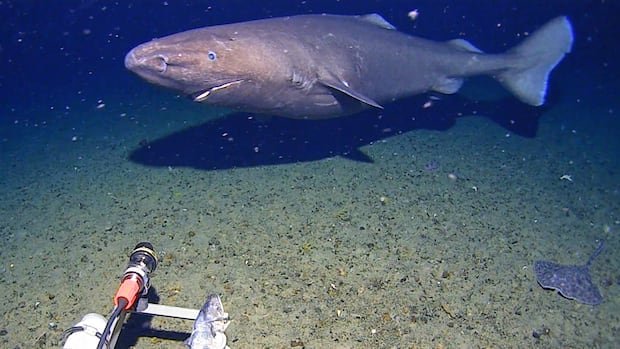

An unexpected sighting occurred when a large sleeper shark, estimated to be between three and four meters long, was captured on camera cruising over a desolate seabed in the depths of Antarctica. The discovery, made in January 2025 off the South Shetland Islands near the Antarctic Peninsula, defied the belief that sharks do not inhabit the frigid Antarctic waters.
The footage, obtained by the Minderoo-UWA Deep-Sea Research Centre, revealed the shark at a depth of 490 meters where the water temperature was a chilling 1.27 degrees Celsius. Researchers were surprised to see such a significant shark in this region, as it contradicted the conventional notion that Antarctica is devoid of sharks.
The shark’s presence at that depth was attributed to the warmest layer of water near the seabed, where it likely fed on the remains of whales, giant squids, and other marine organisms that sink to the ocean floor. While the sighting raised questions about the impact of climate change on shark distribution in the Southern Hemisphere, limited data exists due to the remote nature of the Antarctic region.
Experts noted that the shark’s appearance in the Antarctic Ocean was a rare occurrence, with no previous records of sharks found so far south. The population of sleeper sharks in this region is believed to be sparse and challenging to detect, emphasizing the significance of capturing such footage.
The unique underwater ecosystem of the Antarctic Ocean, characterized by layered water columns and diverse marine life, provides a habitat for elusive species like the sleeper shark. Further research is needed to understand the dynamics of this ecosystem and the potential impact of environmental changes on its inhabitants.
Despite the challenges of studying the deep Antarctic waters, researchers remain optimistic about uncovering more surprises and insights into the mysterious world beneath the ice.