
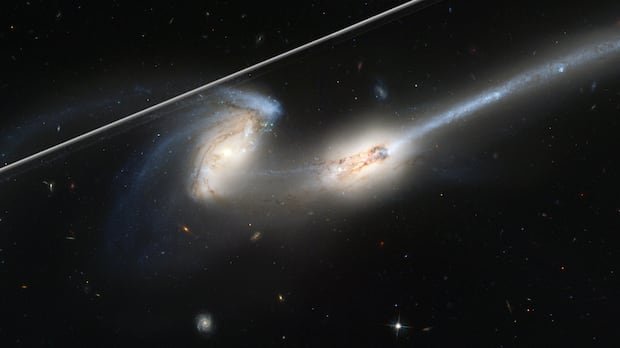

Satellite constellations, which consist of networks of multiple satellites ranging from a few dozen to tens of thousands, are causing disruptions to scientific research conducted using ground-based telescopes. However, a new study is now examining the potential impact they may have on space telescopes like the Hubble Space Telescope.
The Hubble Space Telescope has not only captured stunning images of galaxies and nebulas that captivate us, but it has also made significant scientific breakthroughs, such as determining the rate of expansion of our universe.
The study, published in Nature, focuses on the potential effects of satellite megaconstellations on Hubble, NASA’s SPHEREx, the European Space Agency’s proposed ARRAKIHS, and China’s planned Xuntian telescope. The research indicates that if the projected 560,000 satellites are launched into orbit in the next decade, around 39.6% of Hubble images and 96% of images from the other three telescopes would be impacted.
These satellites, as they move across the sky, leave long streaks of light in telescope images and can also disrupt radio astronomy by emitting electromagnetic radiation at low frequencies.
Lead author Alex Borlaff, a NASA research scientist, noted the increasing frequency of satellite sightings passing in front of telescopes, posing a threat to astronomical research. The proliferation of satellites in orbit, fueled by companies like SpaceX and Amazon, has raised concerns about the interference with space-based telescopes.
The surge in satellite launches, driven by reduced costs and enhanced technology, aims to improve global internet access, particularly in remote areas. Despite efforts to mitigate these disruptions, the study suggests that the constant presence of satellites could pose a significant challenge to astronomical observations.
As the number of satellites in orbit continues to rise, astronomers face challenges in safeguarding their research and preserving the sanctity of the night sky. The implications of satellite constellations extend beyond scientific endeavors to impact cultural connections to the stars and potential environmental repercussions, underscoring the need for careful consideration of their proliferation.