
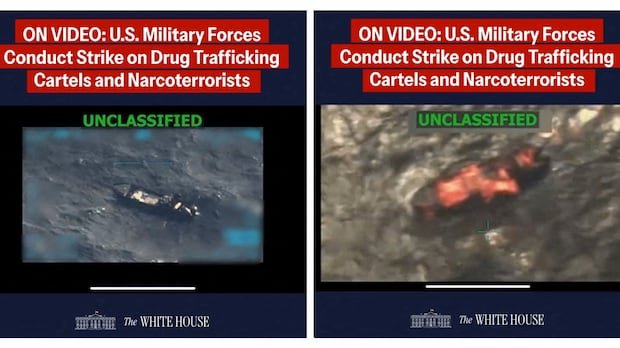

U.S. President Donald Trump confirmed on Friday that a U.S. military strike targeted an alleged “drug-carrying submarine” in the Caribbean. The strike resulted in the deaths of two individuals, while two survivors are reportedly being held aboard a navy ship. During a meeting with Ukrainian President Volodymyr Zelenskyy at the White House, Trump stated that the submarine was specifically designed for transporting large quantities of drugs. He did not provide details on the casualties or the number of survivors. Secretary of State Marco Rubio acknowledged the presence of survivors but mentioned that further information would be provided later. The information about the survivors was disclosed by Reuters, citing reliable sources.
This development suggests that the survivors of the recent strike may be considered the first prisoners of war in the conflict initiated by Trump against a perceived “narcoterrorist” threat originating from Venezuela. The Pentagon has yet to comment on the matter, despite requests for clarification.
Prior to this operation, U.S. military actions against suspected drug boats near Venezuela had not resulted in any known survivors. These strikes commenced in early September, with official videos depicting the destruction of vessels, yet no information regarding the individuals onboard or the cargo has been publicly disclosed by the administration. Sources have indicated that the targeted vessel on Thursday may have been a semi-submersible, a type of submarine-like craft utilized by drug traffickers to evade detection.
Reports indicate that a helicopter rescue was conducted by the U.S. military to retrieve the survivors of the attack and transport them back to a U.S. warship. The Trump administration’s previous strikes purportedly led to the deaths of 27 individuals, prompting concerns from legal experts, Democratic lawmakers, and some Republican senators regarding the adherence to international laws of war.
Trump recently revealed that he authorized the Central Intelligence Agency (CIA) to carry out covert operations within Venezuela, fueling speculation about U.S. efforts to oust Venezuelan President Nicolas Maduro. The administration has increased the reward for information leading to Maduro’s arrest to $50 million, citing alleged connections to drug trafficking and criminal organizations, allegations that Maduro denies. Despite Trump’s claims of Venezuela being a hub for fentanyl trafficking, data shows that Mexico is the primary source of fentanyl, while Venezuela traditionally exports cocaine illicitly.
Colombian President Gustavo Petro suggested that Colombian nationals may have been on previous vessels targeted by U.S. strikes, drawing condemnation from the White House. Concerns have also been raised by Trinidad and Tobago fishermen, who rely on the seas for their livelihood and fear the repercussions of ongoing military actions in the region.
The U.S. military presence in the Caribbean has intensified, with the deployment of guided missile destroyers, F-35 fighter jets, a nuclear submarine, and thousands of troops. Amid escalating tensions with Venezuela, the Pentagon announced the premature resignation of Admiral Alvin Holsey, the commander of U.S. military forces in Latin America. This unexpected move has raised apprehensions among lawmakers, including Senator Jack Reed, about the potential ramifications of a U.S.-Venezuela confrontation.
The Pentagon’s decision to shift leadership of counter-narcotics operations from Southern Command to II Marine Expeditionary Force based in North Carolina has surprised observers, as combatant commands typically oversee such operations.