
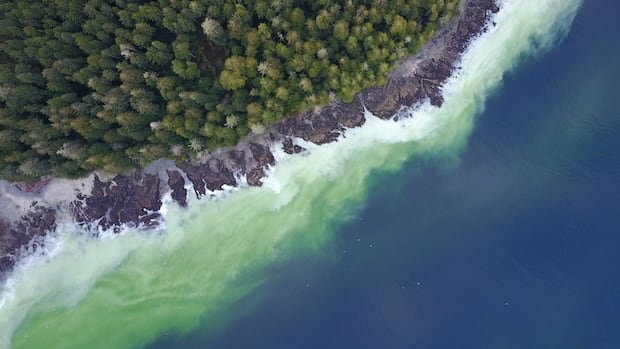

Ryan Cutler observed the ocean turning foamy from his residence close to Salmon Beach on the western side of Vancouver Island last week, signaling the commencement of the herring spawn. Describing it as a remarkable period, Cutler explained that the foamy, milky blue-green water indicated the herring’s gathering for reproduction in the shallow coastal bays.
The herring spawn is a significant event for Vancouver Island and the South Coast, symbolizing the arrival of spring and a time of food gathering for some coastal First Nations. This period also holds importance for marine conservation efforts due to the decline in herring populations resulting from overfishing over the past few decades.
Herring, as a critical species, group together to reproduce, with females laying eggs on kelp and eelgrass while males release milt, giving the water a milky appearance. Cutler noted the signs of staging, where herring gather and prepare to spawn, were evident in the weeks leading up to the event, accompanied by the presence of sea lions, eagles, and humpback whales.
Nick Chowdhury, president of the Island Marine Aquatic Working Group, emphasized the spawn’s relevance to coastal First Nations, marking a time for seasonal shifts and food gathering. The sighting of the initial spawn at Salmon Beach sparked excitement, allowing for the assessment of fish stocks and notable returns to areas where spawning had not occurred for some time.
Chowdhury stressed the importance of tracking the spawn through their Facebook page to understand the impact of conservation efforts on stock management and fishing quotas. He highlighted the progress made in transitioning from a mindset of unlimited fishing to a more sustainable approach.
Shirley Louie, a seasoned fisher and Stz’uminus First Nation member, shared her journey of learning about herring, recounting her involvement in a documentary project about the fish initiated by the Q’ul-lhanumutsun Aquatic Resources Society. Louie expressed the value of rediscovering traditional practices like smoking and frying herring, emphasizing the need to reconnect with indigenous smokehouses and traditional foods.