
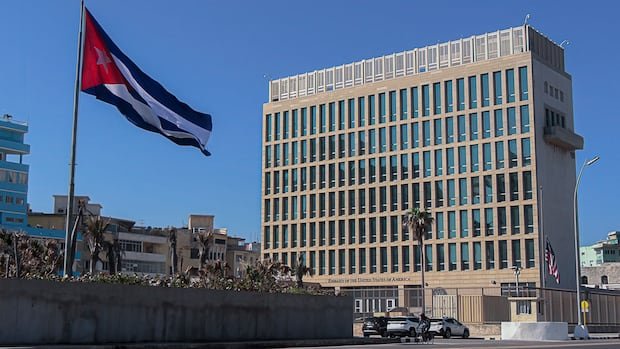

The U.S. imposed financial sanctions on a vast business conglomerate managed by Cuba’s military and a Cuban-Canadian mining joint venture. This move is part of the Trump administration’s efforts to increase pressure on Cuba’s communist leadership by targeting foreign investment sources. Following the military operation to capture Venezuela’s leader, a close ally of Cuba, in January, President Trump indicated that Cuba would be the next focus. The administration has disrupted most oil shipments to Cuba, exacerbating power shortages on the island.
Recently, President Trump signed an executive order expanding U.S. sanctions against Cuba, a decision criticized by Cuban President Miguel Díaz-Canel as “coercive.” The order specifically targets Grupo de Administracion Empresarial S.A. (GAESA), a military conglomerate believed to control a significant portion of Cuba’s economy, along with its Executive President Ania Guillermina Lastres Morera. U.S. Secretary of State Marco Rubio accused Cuba of facilitating intelligence operations for countries hostile to the U.S., a claim Cuba denies.
Furthermore, the sanctions also affect Moa Nickel SA, a partnership between Sherritt International Corp based in Toronto and Cuba’s state-owned nickel company. This joint venture, involved in nickel and cobalt mining, represents a key source of foreign exchange for Cuba. The Trump administration has implemented strict restrictions on U.S. travel and remittances to Cuba and discouraged regional allies from engaging Cuban doctors, a program that generates crucial foreign currency for Cuba.
Sherritt, one of the few companies operating on a large scale in Cuba despite heavy U.S. sanctions, announced the immediate suspension of its direct involvement in joint venture activities in Cuba. The company is arranging the repatriation of its expatriate employees from Cuba and has requested its partners to do the same. Sherritt clarified that its refinery operations in Fort Saskatchewan, Alta., are unaffected, with sufficient materials to continue production until mid-June.
Cuba’s Foreign Ministry condemned the latest U.S. sanctions as “ruthless economic aggression” and a violation of international law. The Ministry urged the international community to address what it described as a dangerous escalation by the U.S. in attempting to control Cuba’s fate.
The U.S. has persistently called for Cuba to liberalize its state-controlled economy, compensate for properties seized by Fidel Castro’s government, and hold transparent elections. Cuba staunchly defends its socialist system and accuses the U.S. of hinting at military intervention to “liberate” Cuba. Cuban officials attribute the country’s economic and social challenges to decades of U.S. sanctions.
Senator Rubio met with military officials at the U.S. Southern Command in Florida this week. The Southern Command oversees U.S. operations in the Caribbean region. Rubio emphasized that the new sanctions reflect the U.S. government’s commitment to safeguard national security in the hemisphere. The Senator pledged continued action until Cuba implements necessary political and economic reforms.
The imposition of sanctions followed Rubio’s discussions with Pope Leo at the Vatican, where concerns about escalating tensions between the U.S. and Cuba were raised, emphasizing the need for dialogue. Additionally, UN experts highlighted the adverse effects of Trump’s fuel blockade on Cuba, labeling it as “energy starvation” with severe implications for the nation’s development and human rights.