
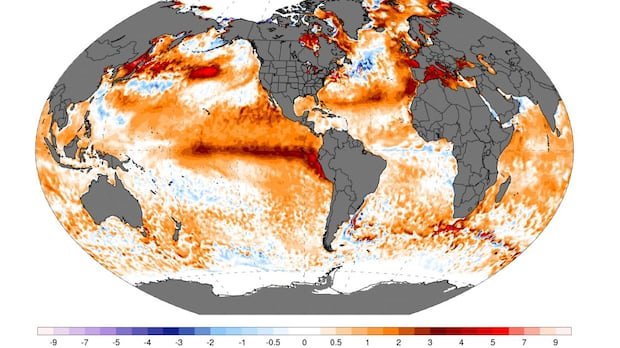

The highly anticipated El Niño phenomenon has finally arrived and is proving to be as impactful as expected. Earlier this year, climate experts predicted the development of an El Niño in the central Pacific region. Subsequently, various models started indicating the likelihood of a strong or even “super” El Niño event. However, scientists cautioned that it was still too early to confirm the intensity.
In their update for June, the U.S. National Oceanic and Atmospheric Administration (NOAA) officially declared the presence of warmer conditions in the specific Niño 3.4 region of the Pacific Ocean, meeting the criteria for an El Niño event. Typically, a temperature anomaly of 0.5°C above the average is required to classify as El Niño, but current ocean temperatures are nearly 2°C higher, marking a record-breaking warmth for this time of the year.
According to Zeke Hausfather, a climate scientist at Berkeley Earth, the temperatures in the traditional Niño 3.4 region are already surpassing 2°C, suggesting the onset of very strong El Niño conditions, possibly leading to a “super” El Niño. The peak of this El Niño event is anticipated by some forecasts to occur in October, although the majority of models indicate a more likely peak in November or December.
El Niño and La Niña are phases of the larger El Niño Southern Oscillation (ENSO) cycle, affecting the Pacific Ocean region. While La Niña brings cooler temperatures, El Niño results in warmer conditions, impacting global weather patterns. The rapid transition from La Niña to El Niño, as observed this year, has surprised meteorologists due to the swift change in oceanic conditions over just one year.
The possibility of a significant El Niño event with temperatures potentially exceeding historical records raises questions about the role of climate change in intensifying these phenomena. While uncertainties remain regarding the exact influence of climate change on El Niño events, experts are closely monitoring the situation for potential impacts on agriculture, ecosystems, and weather patterns worldwide.
As the El Niño event unfolds, concerns arise about its potential implications, particularly on food security in tropical regions and the heightened risk of wildfires in Western Canada due to expected dryer conditions. It is evident that El Niño is a serious phenomenon with far-reaching consequences that necessitate proactive preparation to mitigate its effects.