
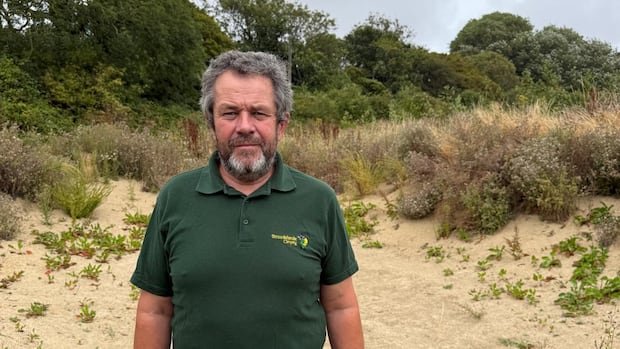

In the countryside of southern England, James Baird, a nature-friendly crop farmer, stood in his field and gestured towards deep cracks in the dry earth. Baird, who has been farming for over four decades at Stroodelande farm in West Sussex, expressed astonishment at the unprecedented conditions of this summer. The cereal harvest concluded much earlier than usual, with crop yields plummeting by 25 percent.
Contrary to the typical perception of the UK as a rainy place, the past five years have witnessed recurring droughts, indicating emerging patterns. Baird emphasized that this summer marked the driest period he has encountered in his farming experience, transforming the usually lush and green English countryside into a parched landscape due to prolonged heatwaves and minimal rainfall.
Presently, half of England and the entirety of Wales are officially facing drought conditions following an exceptionally severe dry spell as reported by the UK’s Environment Agency. The scarcity of rain is evident, with England receiving only seven percent of its average July rainfall, and southern England receiving a mere one percent, equivalent to 0.7 millimeters.
The current drought not only challenges traditional English practices but also raises concerns about long-term water security in the country. By 2050, England is projected to encounter a shortfall of five billion liters of water daily, prompting fears of potential food shortages cautioned by the National Farmers’ Union.
The prolonged heatwave has devastated crops, diminished water bodies, and triggered wildfires, leading to hosepipe bans affecting over 20 million residents in England and Wales. The escalating fire incidents have also posed a new threat to farmers, exemplified by Eleanor Gilbert’s heroic efforts to combat a nearby field fire at Rookery Farm in Hampshire.
The prevalent dry conditions have sparked extensive wildfires across England and Wales, with nearly 400 incidents reported in July alone, marking a record-breaking month for firefighting efforts. The intense heat has desiccated vegetation across Western Europe, fostering ideal wildfire conditions, as highlighted by climate experts.
The adverse effects of the drought are prompting farmers like Gilbert, Baird, and Christensen to adopt new strategies to cope with the arid conditions. Measures such as enhancing soil moisture retention by incorporating organic matter, transitioning to more resilient crops like wheat, and safeguarding livestock from heat-induced stress are being implemented to mitigate the impact of the ongoing drought.
The water management sector is gearing up to address the water scarcity issue through the construction of reservoirs, although the completion of such projects is expected to stretch until the early 2030s. Simultaneously, concerns have been raised over the government’s approval of water-intensive data centers amid the water conservation efforts, reflecting a contradictory stance on water usage in the country.
Apart from agricultural implications, the drought is reshaping the waterway networks in the UK, affecting individuals residing on boats and narrowboats. Low water levels are causing closures and disruptions, underscoring the challenges faced by boat dwellers like Charlotte Bownass and Nici Griffin as they navigate the country’s canals and rivers amid fluctuating water conditions.