
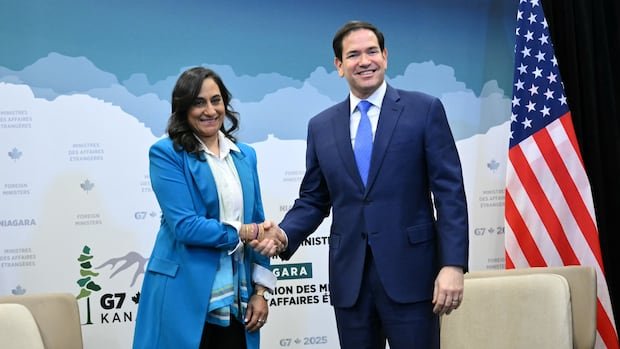

Top diplomats from the Group of Seven countries convened in the Niagara region this week to address global challenges. However, Canadian Foreign Affairs Minister Anita Anand stated that she did not discuss the stalled trade negotiations between Ottawa and the United States during the summit.
Anand and U.S. Secretary of State Marco Rubio held discussions on various topics such as Ukraine, the Middle East, Haiti, and Arctic sovereignty while meeting on the sidelines of the summit. When asked about talks on Canada-U.S. trade, Anand emphasized that Trade Minister Dominic LeBlanc is handling that matter diligently.
Canada’s G7 presidency concluded with Anand advocating for multilateralism and strengthening new trade partnerships in response to the tariffs imposed by the Trump administration. Anand extended invitations to countries like Australia, Brazil, India, Mexico, Saudi Arabia, South Africa, and South Korea to participate in these efforts.
The U.S. military’s actions in the Caribbean, particularly the strikes on boats in international waters, overshadowed the two-day meeting in Niagara-on-the-Lake. The U.S. Secretary of War, Pete Hegseth, confirmed additional casualties from the recent strike, bringing the total death toll to 76.
Despite the controversies, the G7 foreign ministers, representing Canada, France, Germany, Italy, Japan, the United Kingdom, the United States, and the European Union, jointly addressed various geopolitical challenges. They expressed strong support for Ukraine in the face of recent attacks on its power grid by Russia.
Furthermore, new sanctions targeting Russia were announced by Anand, focusing on individuals and entities involved in Russia’s drone and cyber attacks on Ukraine. These sanctions, aligned with actions taken by the U.S., the EU, and the UK, aim to increase economic pressure on Russia in response to its aggressive actions.