

University of Waterloo doctoral student Kaveeshan Thurairajah, though not a Nobel Prize winner, has secured an Ig Nobel Prize. The Ig Nobels, a humorous counterpart to the prestigious Nobel Prizes, acknowledge unconventional and innovative research in academia.
Thurairajah and his team were awarded the Ig Nobel Physics Prize for their work on developing a splash-free urinal. Thurairajah recalls the moment when his supervisor, fluid physicist Zhao Pan, shared the news of their victory. Celebrating with a bottle of wine from Pan’s office cupboard, they toasted their success using espresso cups.
The scientists designed and tested various urinal prototypes, including the Nautilus and Cornucopia models, aiming to create an efficient and easy-to-clean solution. Thurairajah highlighted the Nautilus design as superior due to its reduced splash and improved cleaning ease.
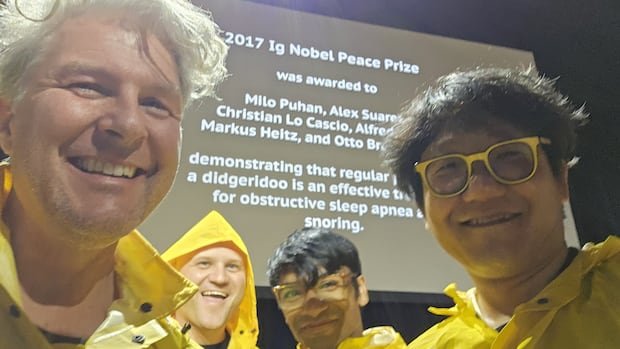
Attending the award ceremony in Zurich, clad in bright yellow raincoats, Thurairajah and his team received recognition from their peers in the scientific community. Despite the nature of their research, Thurairajah clarified that no actual urine was involved in their experiments.
While acknowledging the absurdity of their work, Thurairajah emphasized the practical significance of their research in enhancing public facilities. Their findings were published in the journal PNAS Nexus.
In addition to Thurairajah’s team, other Canadian researchers were honored at the event. A University of Toronto group received the Economics Prize for their study on unethical behavior, while McGill University scientists were part of the team recognized for their innovative use of mosquito proboscises in 3D printing.
The Ig Nobel Awards, hosted by the Annals of Improbable Research, relocated to Europe after 35 years in the United States due to visa concerns. Thurairajah stressed the importance of international collaboration in the scientific community and expressed support for the decision to move the event to Europe.
The quirky Ig Nobel Awards also recognized research on various topics such as the evolutionary history of kissing, the science of blowing one’s nose, and the decomposition of underwear in different environments. Researchers from around the world were celebrated for their unconventional contributions to science.