
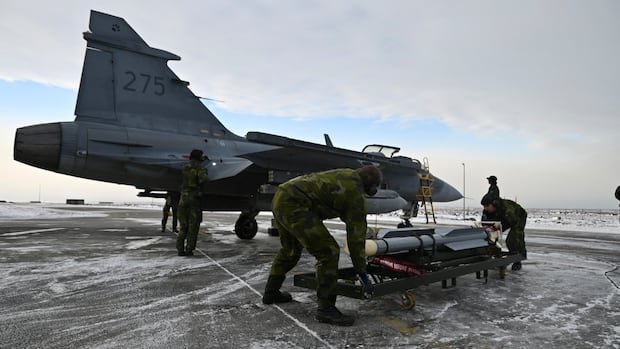

The U.S. may exert pressure on Canada if Prime Minister Mark Carney’s Liberal government opts to reduce its F-35 procurement in favor of the Gripen. Critics supporting the Lockheed-Martin stealth fighter have raised concerns about the Gripen’s interoperability with American aircraft and NORAD. However, recent joint exercises in Iceland have shown that Danish F-35s and Swedish JAS-39 Gripens can effectively operate together.
The successful collaboration is facilitated by the Link 16 system, incorporating advanced anti-jamming and encryption features such as the multifunctional information distribution system (MIDS). This system is vital for NATO and NORAD coordination, requiring approval from the U.S. for countries seeking integration with American forces.
Amid geopolitical tensions, there are fears that the Trump administration might restrict Canada’s access to encryption terminals for the Gripen. While this scenario remains uncertain, Lt.-Col. Johan Legardt from Sweden’s NATO detachment in Iceland acknowledged the potential consequences if the U.S. were to block Canadian Gripen purchases.
Trump administration officials have hinted at concerns regarding sharing classified data in the presence of Gripen fighters, especially within NORAD’s communication network. Defense expert Rob Huebert speculates on potential repercussions, citing the need for increased F-35 procurement if Canada opts for Gripen jets.
Saab, the Gripen manufacturer, asserts that their aircraft meets Canada’s security and interoperability requirements, having passed evaluation tests. Former Saab pilot Jussi Halmetoja emphasizes the importance of the Link 16 terminal for communication parity with the F-35.
The Carney government continues to assess the F-35 procurement, with Saab vying to supply over 70 Gripen fighters to Canada. Despite initial skepticism, recent joint exercises in Iceland involving Gripens, F-35s, and Eurofighters demonstrate successful interoperability and cooperation among different aircraft models.