
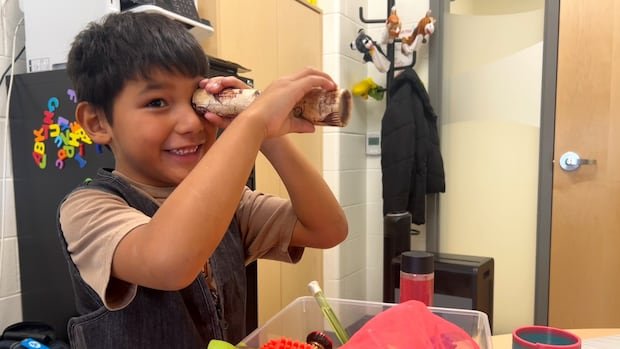

When Kade Francis was about one year old, doctors informed his mother that they suspected he was on the autism spectrum and might never speak. Fast forward to today, and Kade, now six, is an enthusiastic Grade 1 student at Elsipogtog School, confidently participating in class discussions. Krystal Francis, his mother, expressed immense pride in her son’s remarkable progress, attributing it to a pioneering program at the kindergarten to Grade 8 school, catering to 350 students from the Mi’kmaw community.
Krystal shared her initial concerns about what the future held for Kade, stating how challenging it can be for autistic children in a world not tailored to their needs. The school’s comprehensive program, offering early screening, diagnosis, and tailored support, played a pivotal role in Kade’s development from his early years.
Debbie Maund, a speech language pathologist at Elsipogtog School, highlighted the team’s use of Indigenous-led principles to assess students, diagnose conditions, and provide specialized teaching within the school premises. The program’s evolution over the past decade saw the team expand to include various professionals like occupational therapists, counselors, and literacy experts, working hand in hand with external physicians to diagnose and support children with various conditions.
The dedicated team at Elsipogtog School devises personalized learning plans for each student, partnering with teachers and parents to ensure consistent support until the students graduate from Grade 8. The program’s emphasis on early screening not only enhances educators’ understanding of students’ needs but also fosters a trusting relationship between educators and families.
Occupational therapist Christine Agnew, a familiar face to Kade since his nursery days, provides one-on-one sessions to help students like him develop essential skills and strategies for learning. The program’s holistic approach extends beyond academic subjects to focus on fine motor skills, daily routines, language development, and cultural teachings.
Ivan Augustine, the education director at Elsipogtog First Nation, emphasized how the program nurtures resilience in students, preparing them to overcome challenges and pursue higher education. The growing awareness and acceptance of the school’s program within the community have alleviated concerns about stigma, encouraging parents to seek support for their children without hesitation.
Funding from Jordan’s Principle has been instrumental in the program’s expansion, ensuring essential services for First Nation children. However, ongoing financial support remains a critical concern for the sustainability of the program, as highlighted by Francis and Augustine. The unwavering support provided by the program’s dedicated team has not only transformed the lives of students like Kade but has also offered a sense of belonging and community for families facing similar challenges.