
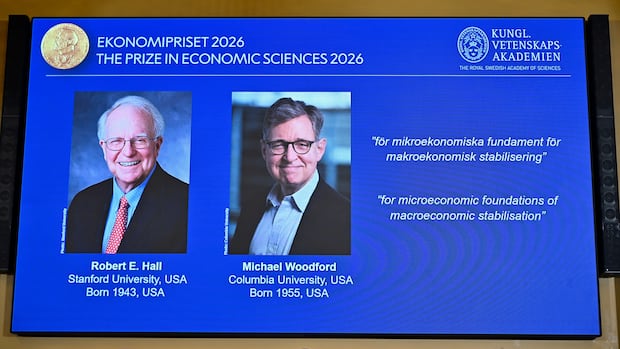

On Monday, American economists Robert E. Hall and Michael Woodford were awarded the Nobel memorial prize in economics for their contributions to models that assist governments and central banks in navigating economic disruptions.
The Royal Swedish Academy of Sciences revealed the recipients in Stockholm, highlighting their achievements in aiding policymakers to manage economic volatility.
According to a statement from the academy, “The laureates have contributed to smoothing out the fluctuations in the economy.”
Hall is associated with Stanford University in California, while Woodford is connected to Columbia University in New York.
Speaking to the committee from New York on Monday, Woodford expressed, “It’s a tremendous honour, and I was surprised.”
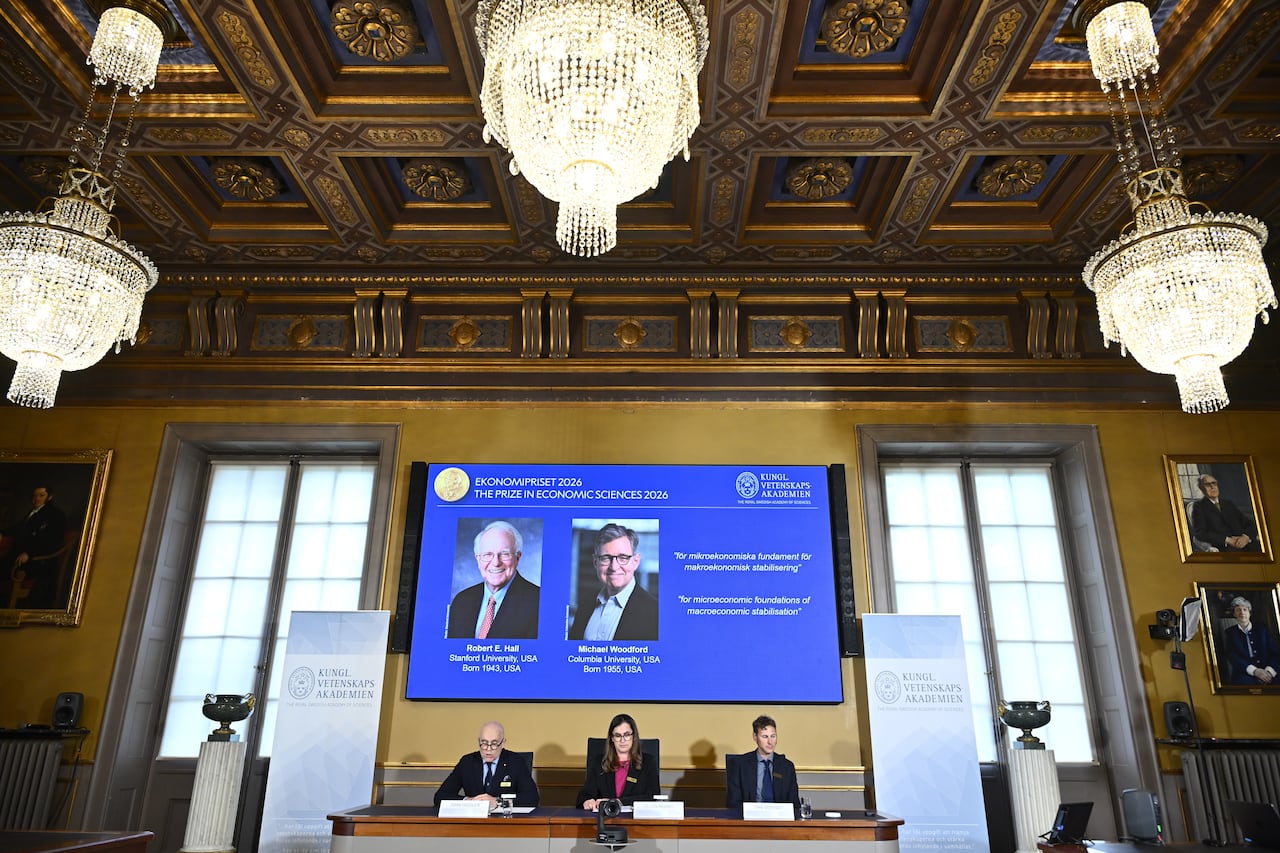
The Nobel memorial prize in economics was announced in Stockholm on Monday, with Hall and Woodford recognized for their development of models aiding governments and central banks in managing economic shocks. (Anders Wiklund/TT News Agency/The Associated Press)
John Hassler, chair of the Committee for the Prize in Economic Sciences, mentioned in a news release, “The work of the laureates has laid a stable theoretical groundwork for the models employed by central banks and governments globally.”
“Thanks to their contributions, we are now better prepared to respond to economic shocks, such as energy crises or abrupt shifts in household consumption.”
‘A New Basis for Stabilization Policy’
Historically, governments have reacted to economic shocks by adhering to the principles established during the Great Depression by British economist John Maynard Keynes: stimulating the economy through tax reductions and increased government expenditure, encouraging consumer and business spending to jumpstart growth.
Timo Boppart from the Nobel economics prize committee remarked, “This Keynesian approach was effective — until it ceased to be so.”
-
He won the Nobel Prize for his work understanding the brain — and his kids flipped out
-
Audio
Anne Carson just won the Nobel Prize for Literature. We learn more about her literary legacy
Economists previously believed that managing the economy involved straightforward trade-offs; for example, low unemployment would accompany high inflation, while unemployment would increase when inflation decreased.
However, the “stagflation” crisis of the 1970s, which saw a simultaneous rise in inflation and unemployment, revealed the inadequacy of this model.
Hall and Woodford sought to create a more refined model that factored in how consumers and businesses make decisions regarding investment and spending.
“Through their separate contributions, Robert E. Hall and Michael Woodford have established a new foundation for stabilization policy,” Hassler stated.
In the previous year, three researchers, including Canadian economist Peter Howitt, were awarded for their work explaining how innovations and new products enhance economic growth and human welfare, often at the expense of older companies.
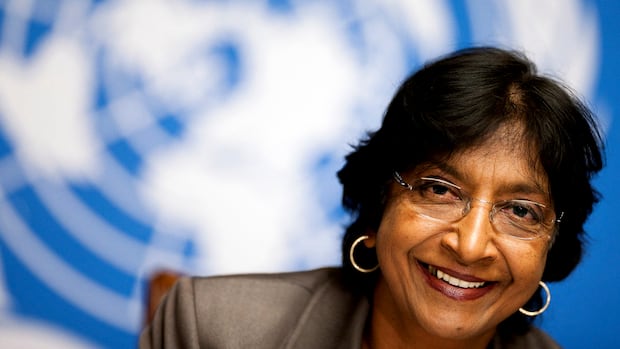
South African jurist Navanethem (Navi) Pillay has been awarded the 2026 Nobel Peace Prize for her contributions to advancing human rights and international law. Her career includes investigations into atrocities in Rwanda, Myanmar, and Gaza, which drew significant criticism from Israel.
The economics prize is officially called the Bank of Sweden Prize in Economic Sciences in Memory of Alfred Nobel.
It was established by the central bank in 1968 as a tribute to Nobel, the 19th-century Swedish entrepreneur and chemist known for inventing dynamite and founding the five Nobel Prizes.
Proponents of Nobel’s legacy emphasize that the economics prize is not technically classified as a Nobel Prize, but it is always awarded alongside the others on December 10, which marks the anniversary of Nobel’s passing in 1896.
Nobel prizes were announced last week across various fields, including medicine, physics, chemistry, literature, and peace.
This year’s prize purse is set at 12 million Swedish kronor (approximately $1.7 million Canadian), awarded to either an individual, a small group of laureates, or an organization.