


The groundwork for a new energy “powerhouse” in Canada was laid during the summer of last year, coinciding with rising trade tensions with the United States and Ottawa’s intensified initiative for new infrastructure development. At this pivotal moment, two companies from opposite ends of the country found themselves at a critical juncture.
On Tuesday, Emera Inc., headquartered in Halifax, and Calgary’s Canadian Utilities revealed their intentions to merge into a new entity valued at $72 billion, which would position them among the largest utilities in North America, equipped to capitalize on the surging demand for electricity.
Simultaneously, Atco Ltd., which holds a controlling stake in Canadian Utilities, is repositioning itself as a more agile firm that emphasizes defense, housing, and other infrastructural projects—particularly in distant and remote areas—as these priorities gain traction with government agendas.
Nancy Southern, CEO of Atco, mentioned that Scott Balfour, her counterpart at Emera, had reached out about this potential merger 15 months ago.
“Scott is a true patriot and a dedicated Canadian, just like me. He started envisioning how we could create a formidable Canadian energy powerhouse,” she stated.
Southern reflected that around the same period, she had also been contemplating how Canadian Utilities, where she is the executive chair, could achieve the necessary scale to meet the increasing needs of artificial intelligence data centers and the growth of electrification for sustainable energy.

The parent company of Nova Scotia Power, ATCO and Canadian Utilities announced its plan to merge this week. Scott Balfour, president and CEO of Emera, will lead the merged company.
“What steps do we need to take to reach the next level?” she questioned.
Emera was also in the midst of reevaluating its portfolio, enhancing its financial position, and preparing for the next growth phase while a sense of “Canada Strong” was gaining momentum nationwide, Balfour noted in an interview.
“It’s time to establish a true Canadian champion that can foster growth while possessing the financial strength to support the urgent demand for new infrastructure in this nation,” he recalled considering.
The merged utility will operate under the Emera name, with its public headquarters remaining in Halifax and corporate and operational facilities located in Calgary and Edmonton. Balfour will continue to lead the organization. Following the merger, Emera will cater to approximately six million customers across Canada, the United States, Mexico, the Caribbean, and Australia.
-
N.S. premier fires off warning to incoming CEO of power utility
-
Nova Scotia Power appoints new president and CEO
The newly formed Emera-Canadian Utilities intends to invest $32 billion in capital by 2030. Emera anticipates that 80 percent of its operations after the merger will be concentrated in Florida and Alberta, both recognized as high-growth areas in North America.
Southern will continue leading a more focused Atco while also co-chairing the Emera board.
“Once the merger and transaction are finalized, you will witness a reimagined Atco—entrepreneurial, competitive, and unafraid of challenging environments, backed by a team with substantial experience,” she informed analysts during a conference call earlier on Tuesday.
She indicated that it was the appropriate time for the family-owned business to divest its stake in Canadian Utilities, a relationship that has existed since 1980.
“From a strict utility perspective, we no longer see ourselves being able to compete effectively in an environment where scale is increasingly crucial,” she remarked.
“As a family, we have never wanted to constrain our businesses, and we view it as essential to allow them to explore the available opportunities.”
This strategic shift also enables Atco to focus on pursuing prospects in defense, energy security, and housing—key areas prioritized by Prime Minister Mark Carney’s administration as it navigates a challenging international trade landscape, affordability challenges, and geopolitical instability.
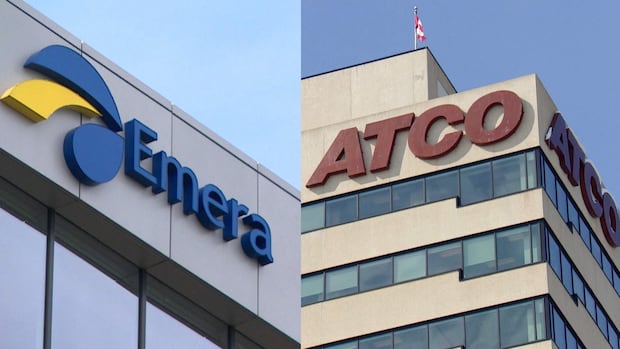
A deal involving Alberta-based ATCO could create one of Canada’s largest utilities. As CBC’s Ted Henley reports, Canadian energy services company Emera says it will acquire ATCO-controlled Canadian Utilities in a $14.3 billion deal amid booming electricity demand.
Southern expressed during the interview that the investor demographic that has traditionally favored Atco for its utility business may change. She pointed out that its infrastructure services had been overshadowed when considered alongside the power sector.
“We firmly believe this will unlock greater value for Atco’s operations, leading to a shift in ownership. Atco will be smaller in scale, which will likely make it less appealing for indexed investors,” Southern commented.
“We will need to invest considerable effort in explaining and educating stakeholders about the new landscape of the two companies post-transaction.”
-
ATCO chief executive sees ‘astounding’ opportunities in northern defence
-
ATCO blames Alberta power policies as it devalues wind and solar projects by $408M
As part of the agreement, Emera will acquire all outstanding shares of Canadian Utilities, which are valued at approximately $14.3 billion. Current Emera shareholders are projected to own about 60 percent of the new utility, while former shareholders of Atco and Canadian Utilities will hold around 40 percent.
Shareholders from Emera, Canadian Utilities, and Atco are scheduled to vote on the merger early next year. The transaction is also contingent upon approvals from courts, regulatory bodies, competition authorities, and stock exchanges across multiple jurisdictions.
MORE TOP STORIES
-
RCMP warn of new scam involving the purchase of gold
-
N.S. small business owners struggle to stay afloat in tariff vortex
-
Eastern Shore parent handed ban for harassing young minor hockey referee
-
Years-long wait to see a gynecologist has N.S. woman considering care elsewhere
-
Video
Bedford man seeks answers about brother’s death in Maine