
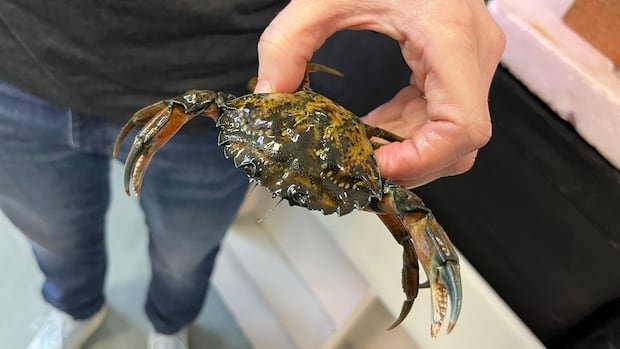

In recent years, the European green crab, a small yet aggressive species, migrated to the Magdalen Islands and is now posing a potential threat to the Gaspé region, according to researchers in Quebec. Initially sighted off the Magdalen Islands coast in 2004, the green crab population has significantly increased since around 2023.
Recognizable by its serrated, pentagon-shaped shell and capable of reaching sizes up to 10 centimeters, the green crab has been thriving in the area. While the impact is not as severe as in other provinces, experts in the Lower St. Lawrence region are closely monitoring its movements to anticipate its future migration patterns.
Piero Calosi, a professor specializing in evolutionary physiology and biology at the Université du Québec à Rimouski, attributes the green crab’s spread to the rising temperatures in the Gulf of St. Lawrence. The warming waters have expedited the migration process beyond initial expectations.
The green crab’s diet includes around 150 different organisms, ranging from mussels and clams to young lobsters, which threatens the local marine ecosystem. Kathleen MacGregor, an aquatic sciences biologist with Fisheries and Oceans Canada, predicts that due to climate change and evolving water temperatures, the green crab could expand its range to areas like the Côte-Nord.
To combat the spread, efforts have been made to trap and freeze green crabs on the Magdalen Islands. The Comité ZIP, an environmental advocacy group on the islands, has collaborated with researchers to capture and dispose of these invasive species. However, concerns remain about the destruction of eel grass beds by the green crabs, impacting various marine species that rely on these habitats.
While the green crab may have some utility as bait, its commercial value is limited due to its small size and challenging flesh extraction process. Researchers emphasize that the economic damage caused by the green crab in Atlantic Canada is estimated to be as high as $23 million. In Quebec, the fishing industry is bracing for the potential arrival of this species, particularly its impact on the lobster stock.