
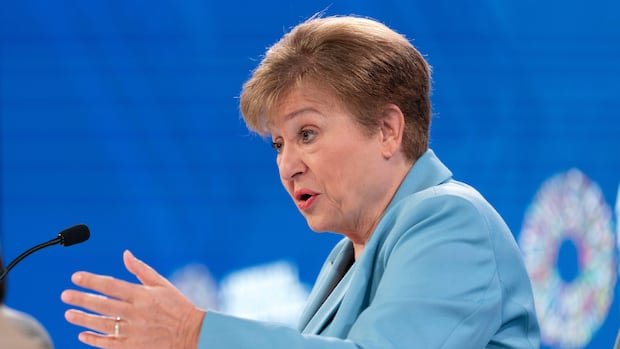

The head of the International Monetary Fund (IMF) has praised Canada’s fiscal standing compared to other G7 nations, despite the Liberal government planning a higher deficit this year. During a press briefing at the IMF’s annual meeting in Washington, IMF Managing Director Kristalina Georgieva highlighted that countries like Germany and Canada are in a relatively stronger fiscal position.
Georgieva recommended that Canada leverage its fiscal flexibility to boost growth, particularly in areas such as housing, infrastructure, and energy. The IMF’s recent report projected a global growth slowdown from 3.3 percent in 2024 to 3.1 percent in 2026, citing risks like prolonged uncertainty, protectionism, and labor supply shocks.
Canada has felt the impact of U.S. President Donald Trump’s tariffs, with growth expected to slow to 1.2 percent this year. The Liberal government, led by Prime Minister Mark Carney, plans to unveil its budget on November 4, aiming to focus on nation-building projects in response to trade challenges. Carney also pledged to meet NATO’s defense spending target by 2026.
Despite the IMF’s positive assessment, the Parliamentary Budget Officer (PBO) raised concerns about Canada’s growing deficit. Interim PBO Jason Jacques described the financial situation as unsustainable, in contrast to former PBO Kevin Page’s view that Canada remains in a favorable fiscal position within the G7.
The government’s decision to present future budgets in the fall, separating operational expenses from capital investments, has received mixed reactions. While some question the broad definition of capital investment, the IMF’s Georgieva welcomed the new budgetary approach as a positive change.