
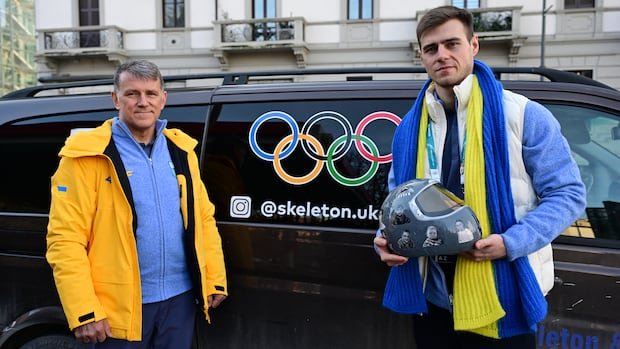

Ukrainian skeleton athlete Vladyslav Heraskevych brought his case to the highest court in sports on Friday, explaining his desire to compete in the Milan Cortina Olympics with a helmet honoring his country’s war victims.
Despite being moved by his story, the arbitrator ruled against Heraskevych, dashing his hopes of any victory at this year’s Olympics. The Court of Arbitration for Sport upheld the disqualification of Heraskevych from the men’s skeleton race, agreeing with the International Olympic Committee and the governing body of the sliding sport that his proposed helmet design violated Olympic regulations.
Heraskevych’s appeal was denied on grounds that his helmet, featuring the faces of over 20 Ukrainian coaches and athletes who perished in the conflict with Russia four years ago, conflicted with the established Olympic rules. The arbitrator supported the IOC’s stance on athlete expression during the Games, emphasizing that Heraskevych could showcase his helmet off the competitive track, such as in interviews and on social media.
While expressing sympathy for Heraskevych’s tribute to the Ukrainian victims of war, CAS affirmed the decision to disqualify him from the competition. The athlete, who had hoped to overturn the ruling, had his disqualification confirmed shortly before the race, rendering the appeal largely symbolic.
Following the hearing, Heraskevych acknowledged the finality of the decision, conceding that he would not be able to participate in the competition. He left the Olympic Village in Cortina d’Ampezzo and traveled to Munich, where he met with Ukrainian officials and received the Order of Freedom from President Volodymyr Zelenskyy.
Zelenskyy praised the resilience of Ukrainians, emphasizing their commitment to truth and the memory of athletes lost due to Russian aggression. Heraskevych, blocked from racing by the IOC and the sports federation, lamented the outcome but remained steadfast in his beliefs.
The IOC defended its rules on athlete expression, citing the need to maintain focus on sporting achievements during competitions. Heraskevych expressed disappointment over the decision, questioning inconsistencies in the enforcement of regulations, particularly in comparison to other athletes’ tributes allowed at the Games.
Despite the IOC’s offer for Heraskevych to compete with an alternate helmet and display his tribute off the racing track, the athlete stood by his principles. Reflecting on the ordeal, he criticized the IOC’s stance, believing it to be against the tide of history.