
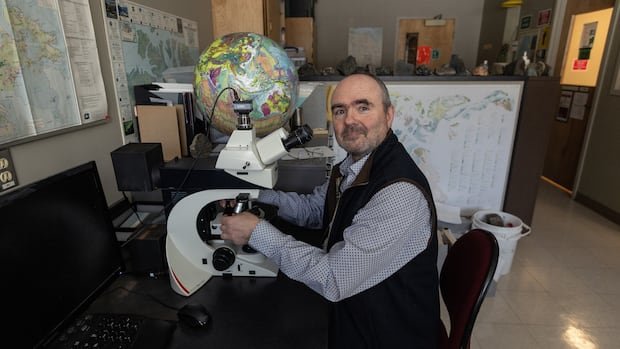

Renowned diamond expert and scholar Graham Pearson has earned a unique accolade in the world of geology with the naming of a newly discovered mineral after him. The mineral, known as Grahampearsonite, was unearthed in Brazil within a deep-Earth diamond. Pearson, a leading mantle geochemist at the University of Alberta, has dedicated years to the study of mantle geology and mineralogy, particularly focusing on diamonds and their insights into the Earth’s inner workings.
The discovery of Grahampearsonite, occurring within a diamond formed at depths exceeding 300 kilometers beneath Brazil’s surface, marks a significant milestone in mineralogical research. The mineral, with a chemical composition of calcium, phosphorus, and oxygen, was previously known in synthetic form and commonly used in products like toothpaste abrasive. However, its natural occurrence in the diamond from Brazil’s Juina region was a groundbreaking revelation.
A team of international researchers, impressed by Pearson’s invaluable contributions to diamond research, chose to honor him by naming the newly identified mineral after him. The mineral was officially christened in December following thorough examination and approval by the International Mineralogical Association.
Pearson’s expertise extends beyond diamond research, encompassing advancements in geochemical analysis techniques and innovative approaches to dating geological samples. His passion for minerals and diamonds has deep roots, stemming from his upbringing in an English mining town. His journey into the world of diamonds was sparked by a mentor’s study on a rare graphite mineral originating from a diamond in Morocco.
Despite the allure of synthetic minerals, Pearson emphasizes the significance of natural mineral discoveries and their untapped potential for various applications. He highlights the exceptional properties of diamonds, not just as sparkling gemstones but as invaluable repositories of geological information reflecting Earth’s intricate processes.
Looking ahead, Pearson anticipates further mineral discoveries with the aid of advanced microscope technology, suggesting that humanity is only halfway through uncovering the vast array of minerals waiting to be found on Earth.