
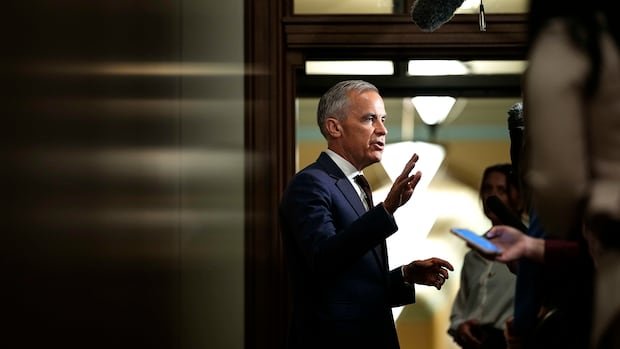

Prime Minister Mark Carney stated that the Canadian economy is undergoing significant changes due to the government’s response to the U.S. trade war. He mentioned that the recent slight economic downturn is a result of the economy adapting to ongoing transformations. Carney emphasized the government’s efforts to strengthen and enhance the Canadian economy through investments, operational changes, and new trade agreements.
Recent data from Statistics Canada revealed a 0.1% decrease in real GDP in the first quarter, following a more substantial contraction in the previous quarter. This consecutive decline technically qualifies as a recession, though some experts, including the Bank of Canada, have advised against overreacting to this news.
Carney highlighted measures taken by the government to address economic challenges, such as reducing immigration to slow population growth and curbing the rate of government spending growth. He noted a significant drop in government spending and investment, which impacted economic performance in the first quarter of 2026.
Despite facing obstacles like declining exports and business investments due to trade uncertainties, Carney pointed out positive trends in machinery and equipment investments, intellectual property, and research and development. Household incomes continue to surpass inflation rates, indicating progress towards a more robust economic foundation.
Economists like BMO’s Douglas Porter identified unexpected declines in government spending and investment as key factors contributing to the economic weakness in the first quarter. Porter acknowledged resilient consumer spending but cautioned against downplaying the economic challenges.
Bank of Canada’s senior deputy governor Carolyn Rogers suggested that the economy likely rebounded in April after two consecutive quarters of GDP contraction. Experts like Scotiabank’s chief economist Derek Holt also questioned the recession label, citing external factors like weather conditions and trade fluctuations affecting economic data interpretation.
Conservative Leader Pierre Poilievre criticized the government’s handling of the recession, labeling it as the only one in the G7 and North America. He called for transparency from the prime minister regarding the economic situation and pushed for a debate on the country’s economic performance. The Conservatives introduced a motion to hold Carney accountable for the recession and proposed reversing current economic policies to improve Canada’s standing in the G7.