
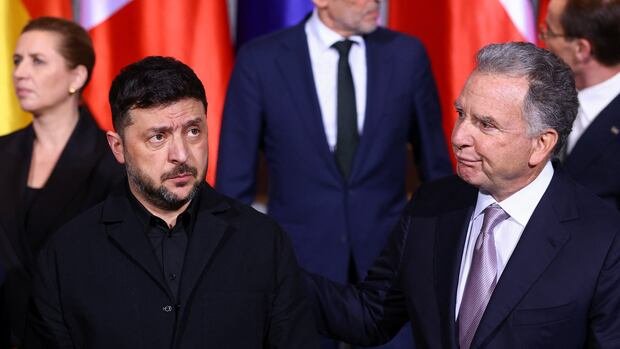

The United States has agreed to offer unspecified security assurances to Ukraine as part of a peace agreement to conclude Russia’s nearly four-year conflict. U.S. officials revealed this information following recent discussions with Ukrainian President Volodymyr Zelenskyy in Berlin. Talks involving U.S. President Donald Trump’s envoys, Steve Witkoff and Jared Kushner, have helped narrow gaps on security guarantees desired by Kyiv and Moscow’s request for Ukrainian land concessions in the Donbas region. Trump participated in a dinner meeting with negotiators and European leaders through a call on Monday evening. Additional negotiations are expected to take place over the weekend, potentially in Miami or another location in the U.S.
The U.S. officials, speaking anonymously, highlighted that the security guarantees offer will not remain on the table indefinitely. They mentioned the Trump administration’s intention to present the guarantee agreement for Senate approval. The specifics of whether it would require two-thirds Senate approval, akin to a treaty, were not clarified.
European leaders in Berlin outlined a commitment to cooperate with the U.S. to provide robust security guarantees, including the formation of a European-led multinational force for Ukraine with U.S. support. This force would operate within Ukraine, assist in rebuilding Ukrainian forces, ensure airspace security, and promote safer seas. The statement also emphasized maintaining Ukrainian forces at a peacetime level of 800,000.
During the discussions, U.S. air force Gen. Alexus Grynkewich, who leads NATO’s military operations and the U.S. European Command, was present. The talks centered on the details of what U.S. officials described as an “Article 5-like” security pact. The U.S. side presented a document to Ukrainian officials with more specific details on the proposed security guarantees, addressing concerns raised about previous versions of the U.S. peace proposal.
German Chancellor Friedrich Merz characterized the agreement as “truly far-reaching and substantial,” emphasizing joint commitments from Europe and the U.S. to the peace process. Despite progress, key issues such as postwar security for Ukraine and the status of occupied territories remain unresolved. Zelenskyy stressed the necessity for legally binding Western security assurances, requiring U.S. Congressional support.
While expressing readiness to forgo Ukraine’s NATO aspirations in exchange for comparable security guarantees, Zelenskyy continues to advocate for NATO membership as the ultimate safeguard against further Russian aggression. Ukraine remains firm in rejecting U.S. pressure to cede territory to Russia. Russian demands include the withdrawal of Ukrainian forces from parts of the Donetsk region under their control.
The U.S. officials indicated a high level of consensus on about 90% of the U.S.-crafted peace plan. Notably, Russia has shown openness to Ukraine joining the European Union, a shift from previous positions. However, Putin views Ukraine’s NATO ambitions as a significant threat to Moscow’s security, prompting the 2022 invasion. Negotiations’ timeline remains uncertain, with Putin’s spokesperson rejecting predictions on a potential peace deal deadline.
In a separate development, the head of Britain’s MI6 intelligence agency accused Putin of prolonging negotiations to end the conflict and employing tactics just below the threshold of war to test Western resolve. Blaise Metreweli underscored Moscow’s aggressive behavior, including cyberattacks, drone activities, and disinformation campaigns. MI6 pledged to enhance its capabilities and confront adversaries, emphasizing the need to outmaneuver hostile tactics without compromising ethical standards.
Additionally, British military chief Air Chief Marshal Richard Knighton warned of Putin’s intentions to undermine NATO, highlighting the evolving threat landscape and the imperative for stronger defense and infrastructure. He stressed the importance of maintaining peace while acknowledging the rising costs of deterrence efforts.