
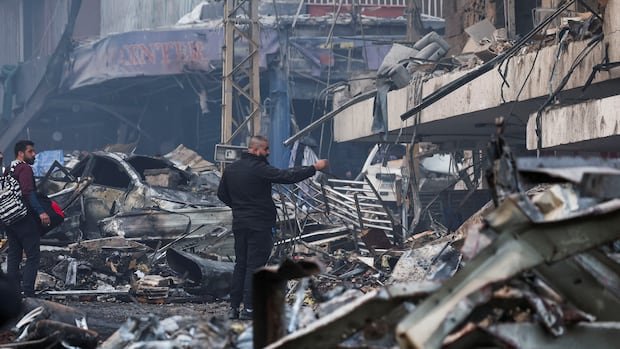

In the early hours of Wednesday in Washington, discussions centered on peace, but over in Beirut, the atmosphere was shattered by Israeli missiles striking over 100 locations in less than ten minutes. Lebanon’s anticipated ceasefire day among Iran, Israel, and the U.S. turned out to be the deadliest of the conflict yet.
While the exact toll is still unknown, Lebanon’s Health Ministry reported more than 100 fatalities and 800 injuries in a series of nearly simultaneous aerial assaults spanning from Beirut to various sites in the south of the country. The precision and synchronization of the attacks drew parallels to the infamous pager attack of September 2024, where Israeli secret service actions caused widespread fear by detonating Hezbollah members’ compromised communication devices, resulting in casualties among militants and civilians.
For Makram Rabah, a history assistant professor at the American University of Beirut, the recent missile strikes hit close to home, echoing a personal connection as areas he frequents were targeted. The Israeli military campaign, dubbed “Operation Eternal Darkness,” purportedly aimed at Hezbollah militants and their infrastructure, led to chaotic civilian scenes on the ground.
The strikes, strategically timed, are seen as signaling messages to both Iran and the U.S., as noted by Andreas Krieg from King’s College London. However, confusion surrounds the ceasefire’s scope, with varying statements from U.S. President Donald Trump, the White House, and Israeli Prime Minister Benjamin Netanyahu, contrasting with assertions from Pakistani mediators who brokered the ceasefire.
The longstanding conflict between Hezbollah and Israel, characterized by cycles of invasions and guerrilla warfare, has escalated over the years, with intermittent ceasefires failing to sustain peace. The recent escalation in March 2026 followed prior skirmishes, leading to renewed hostilities and devastating consequences for civilians caught in the crossfire.
Israeli incursions into southern Lebanon have sparked international condemnation for widespread destruction and displacement of Shia Muslim communities. While internal support for the offensive remains firm in Israel, human rights groups have decried Israel’s actions for their impact on civilians and civilian infrastructure.
In the midst of the turmoil, Lebanon finds itself held hostage between Israel and Hezbollah, with little respite in sight. Makram Rabah’s critique extends to both parties, highlighting the precarious situation facing Lebanon amid the broader geopolitical tensions involving Iran and the United States.
As the conflict continues to unfold, the fragile ceasefire hangs in the balance, with the risk of further escalations looming large and the fate of Lebanon remaining uncertain.