
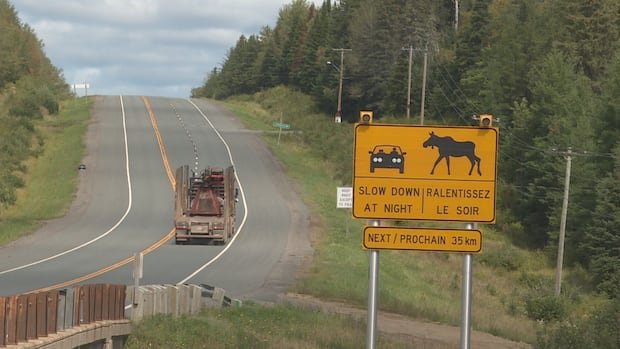

On a late August Saturday night, the Chaleur Lightning hockey team finished an exhibition game against the Miramichi Timberwolves and boarded their bus back to Bathurst. Assistant coach Alex Ouellet recalled a sudden collision with a moose on the highway shortly after departure. Fortunately, the team and coaches escaped unharmed, with only minor scratches on the driver.
The encounter left a lasting impression on Ouellet and the team, a common experience for many New Brunswickers who have faced similar situations. The incident coincided with the province’s announcement of two new wildlife crossings being added to the very stretch of highway where the collision occurred.
New Brunswick employs various methods to deter moose from venturing onto roadways, such as wildlife fencing and crossings. Transportation Minister Chuck Chiasson explained that the placement of these measures is determined by analyzing collision data to identify high-risk areas. Presently, 331 kilometers of highways in the province are lined with wildlife fencing to minimize animal-related accidents.
The province boasts 82 wildlife crossings, including concrete tunnels under highways, with two recent installations on Route 8 between Miramichi and Bathurst. These tunnels, over four meters tall and wide, are designed to accommodate various wildlife species, ensuring safe passage across the roads.
Research conducted on earlier wildlife tunnels indicated successful usage by animals like bears, deer, and moose, emphasizing the importance of intuitive design to encourage animal traffic. These crossings have also facilitated the passage of smaller creatures like beavers, ducks, and bats, showcasing their diverse utility beyond large mammals.
Despite the introduction of wildlife tunnels, collision rates have not significantly decreased, with the highest recorded in 2024. The Department of Transportation continues to prioritize safety by implementing mitigation measures in collision-prone areas, including clearing brush for better visibility.
Looking ahead, Ouellet expressed hope for additional fencing in the area to enhance safety for travelers. While acknowledging the challenges of preventing every crash, he emphasized the importance of proactive measures to mitigate risks on the highways.