
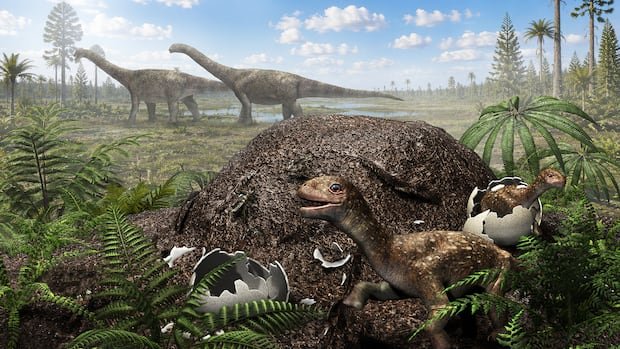

Fossil eggshells believed to belong to some of the largest dinosaurs ever discovered have been unearthed in a surprisingly cool climate located far from the equator. Despite their massive size, the titanosaurs that laid these volleyball-sized eggs couldn’t rely on body heat to keep them warm.
A recent study, co-authored by University of Calgary paleontologist Darla Zelenitsky, along with researchers from Japan and Argentina, delved into the microscopic details of these eggshells to unravel the mystery of how titanosaurs managed to maintain the optimal temperature for their eggs to hatch, without physically brooding over them.
Through an analysis of the eggshell pores, the study suggests that titanosaurs likely employed a similar incubation method utilized by modern crocodiles—burying their eggs in warm piles of decaying vegetation. This technique is thought to have provided the necessary warmth for the eggs to develop and hatch successfully.
Titanosaurs, colossal herbivorous dinosaurs characterized by their long necks and tails, roamed the Earth millions of years ago. Weighing up to 75 tonnes, these giants rivaled the mass of a blue whale. Fossilized eggs known as Fusioolithus, linked to titanosaurs, were previously discovered in warmer regions but were more recently found in the Chorrillo Formation in southern Argentina, dating back to the Late Cretaceous period.
Despite the distance from the equator, the region’s climate at that time resembled that of present-day New York City. The discovery of titanosaurs’ eggs in such a location sheds light on their unique nesting strategies and their ability to adapt to diverse environments for reproduction.
The study highlights the remarkable adaptability of dinosaurs, showcasing how even the largest species found innovative ways to ensure the survival of their offspring. By uncovering the secrets behind titanosaurs’ nesting behaviors, researchers are gaining valuable insights into the reproductive strategies of these ancient creatures and their ability to thrive in varied habitats.