
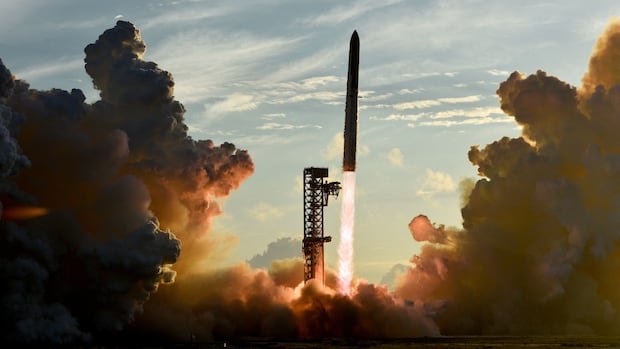

SpaceX successfully launched its massive Starship into orbit, deploying the most advanced Starlink satellites to date before cutting short the mission, with a splashdown in the Pacific Ocean after over three hours. Originally targeting a 10-hour flight encompassing six orbits around Earth to demonstrate readiness for NASA’s Artemis moon program, a hiccup occurred when one engine shut down prematurely after liftoff. Despite this, flight controllers decided to proceed as planned since everything else was functioning well and the faulty engine was deemed unnecessary.
The monumental rocket, designed by founder Elon Musk, carried 26 cutting-edge Starlink satellites to supplement the existing 11,000 models providing internet services. Following a successful deployment of the satellites, SpaceX opted to end the mission prematurely, without providing a specific reason. This launch marked Starship’s 14th full-scale mission from Texas in three years, with previous test flights limited to the Indian Ocean.
SpaceX had aimed for the Starship to circle the Earth six times at an altitude of 275 kilometers over nearly 10 hours, culminating in a splashdown near Chile in the Pacific Ocean. Despite achieving the intended orbit speed of 28,000 km/h, flight controllers erred on the side of caution and decided to bring the Starship back earlier after just a couple of orbits. The booster stage was never intended to return to the launch site, instead descending into the Gulf of Mexico shortly after liftoff.
SpaceX’s goal is to ensure the spacecraft’s functionality before attempting to catch it upon its return to the launch pad, as Musk emphasized the importance of cautious operations to maintain public trust. Pending the results of this orbital debut, the next Starship launch may involve utilizing mechanical arms to capture the spacecraft mid-air, paving the way for potential reuse by the year’s end or early next year.
Certifying the Starship for orbital flight is a crucial step for SpaceX in its ambitions for moon and Mars exploration. With NASA’s Artemis III mission on the horizon, SpaceX is gearing up for a triple-launch docking exercise involving an Orion capsule, competing lunar landers, and Musk’s Starship. The subsequent Artemis IV mission, scheduled for 2028 at the earliest, will see astronauts landing on the moon utilizing either Blue Moon or Starship, with future missions alternating between the two landers.
While originally envisioned for Mars missions, Starship’s current focus is on lunar exploration and satellite launches to replace the Falcon 9 rocket. Additional Starship launch sites are under development, with one nearing completion at Florida’s Kennedy Space Center and plans for a third site in Louisiana.