
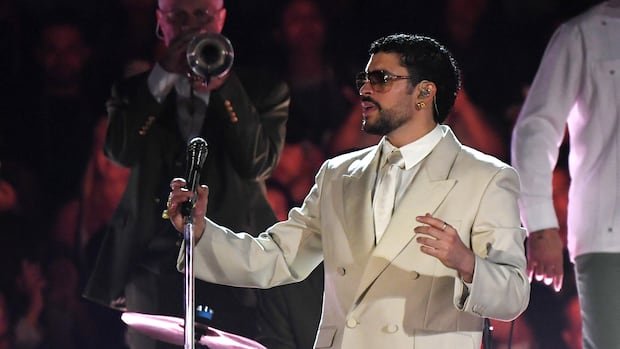

The massive rise of Bad Bunny has put Puerto Rican Spanish, a vibrant Caribbean dialect known for its melodic flow, into the global spotlight. Previously looked down upon, experts believe that the popularity of the Grammy Award-winning artist’s music is challenging those perceptions.
As the anticipation builds for Bad Bunny’s upcoming historic Super Bowl halftime show, entirely in Spanish, numerous tutorials have appeared on social media platforms and YouTube discussing Puerto Rican Spanish terms found in his lyrics. Even language learning platform Duolingo joined in, sharing translations of Bad Bunny’s lyrics on Instagram.
According to Ramón Antonio Victoriano-Martinez, an assistant professor at the University of British Columbia, the use of Puerto Rican Spanish is evident throughout Bad Bunny’s Grammy Award-winning album “DeBÍ TiRAR MáS FOToS.” Victoriano-Martinez pointed out that several song titles are spelled phonetically in the dialect, like the track “VeLDÁ,” which would typically be written “verdad” in standard Spanish, translating to “true” or “truth.”
Victoriano-Martinez noted that the album truly embodies Puerto Rican culture. Over the past decade, he has observed growing interest among students in learning Spanish due to reggaeton artists who incorporate Puerto Rican Spanish in their music.
The linguistic characteristics of Puerto Rican Spanish distinguish it from other Spanish varieties, as highlighted by María Cristina Cuervo, an associate professor at the University of Toronto. Notably, the dialect features the substitution of the “l” sound for the “r” in certain words and dropping the “s” sound at the end of specific words.
Petra Rivera-Rideau, an associate professor at Wellesley College, explained that historically, Puerto Rican Spanish has faced criticism for being perceived as unrefined or inauthentic. This reputation is partly rooted in Puerto Rico’s colonial history and the influence of English terms on the language.
Ana Celia Zentella, a professor emeritus at the University of California San Diego, expressed hope that Bad Bunny’s popularity would foster tolerance and pride among Spanish-speaking individuals for their diverse linguistic backgrounds. She emphasized the importance of linguistic tolerance and justice, especially in the current political climate affecting the Spanish-speaking community.
Bad Bunny’s influence extends beyond music, with his advocacy for linguistic diversity and social justice resonating with audiences worldwide. As his cultural impact grows, he continues to promote respect for all languages and their contributions to society.