
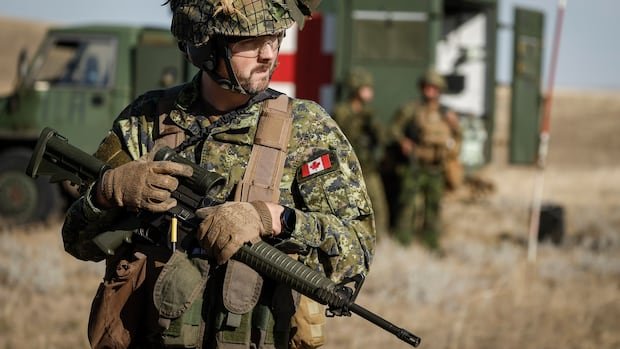

A plan to expedite the replacement of the Canadian military’s outdated assault rifles is in motion, according to information obtained by CBC News. An internal presentation from the Department of National Defence indicates a swift action to procure the initial batch of firearms under the Canadian Modular Assault Rifle program.
Lieutenant-General Mike Wright, the commander of the Canadian Army, confirmed the advancement of the long-standing program, with the anticipation of prompt delivery from a domestic manufacturer. Wright revealed that a contract nearing finalization would ensure the rifles begin arriving for the Canadian Army by the following year, nearly two years ahead of the previous schedule.
This acceleration is made feasible by a substantial injection of over $9 billion into the military, aligned with Prime Minister Mark Carney’s initiative to meet NATO’s defense spending target. The plan outlined in a Defense Department briefing proposes the acquisition of up to 65,401 modern rifles, with a potential to expand deliveries to 300,000, contingent upon the government’s planned expansion of the military supplementary reserve.
While specific cost and delivery timelines are not detailed in the internal presentation, the program’s overall value is estimated to range between $500 million and $1 billion. The Canadian Modular Assault Rifle aims to replace the existing inventory of C7 and C8 rifles, which have been in service since the Afghan war nearly two decades ago.
In addition to the rifles, Lieutenant-General Wright emphasized the significance of new uniforms and highlighted their role in boosting morale. Although the recipient of the contract remains undisclosed, Colt Canada, based in Kitchener, Ont., stands as a potential candidate due to its longstanding ties with the army. Opting for a Canadian supplier would align with the Liberal government’s strategy to enhance the country’s defense industrial base.
The impending rifle procurement serves as a strategic move amid the Defense Department’s pursuit of U.S.-manufactured rocket-propelled artillery, known as HIMARS. While Canada awaits the delivery of the HIMARS systems in 2029 under a $2.7-billion program, the acquisition is met with political sensitivity as the government aims to diversify military acquisitions away from the United States.
Lieutenant-General Wright underscored the necessity of the HIMARS system for long-range precision strikes in land operations, citing its battlefield effectiveness in Ukraine. The army’s modernization efforts extend beyond rifles and artillery to include drones, BV 206 tracked carriers, and the revitalization of the broader army structure, aligning with a recent strategy shift towards preparing for large-scale warfare scenarios akin to those witnessed in Ukraine.
Concurrently, plans for a substantial mobilized force of up to 300,000 supplemental reserves are in the pipeline, aiming to augment the existing strength of approximately 22,500 regular force members and 21,500 primary reserve members within the Canadian Army. Lieutenant-General Wright emphasized the current focus on optimizing existing resources before expanding the force significantly.
Long-term plans include potential reconfigurations of century-old urban armories and a streamlined organizational structure to ensure a swift and effective response to both domestic crises and overseas deployments. The army’s regional divisions are being reevaluated to enhance scalability during emergencies, with recent planning exercises conducted to assess the challenges and readiness for rapid deployment scenarios.