

At The Birds & Beets in Vancouver, Matthew Senecal-Junkeer operates a cafe that transforms from serving sandwiches and coffee during the day to offering wine and small plates at night. Senecal-Junkeer has observed a shift in customer price sensitivity depending on the time of day. Daytime customers carefully consider their choices based on prices, such as selecting oat milk over regular dairy or opting for avocado on a sandwich. This has led to an increase in sales of lower-priced menu items during cafe hours, while pricier items have seen a decline.
In contrast, evening customers at the wine bar exhibit less concern about prices. Senecal-Junkeer notes that patrons are more willing to indulge in expensive menu items without hesitation, viewing it as a luxury experience where they prefer not to focus on minor expenses.
According to a report from Restaurants Canada, the current economic situation reflects a “K-shaped economy,” where individuals with higher incomes continue to spend on dining out, while those with lower incomes are cutting back due to financial constraints. Kelly Higginson, the president and CEO of Restaurants Canada, highlighted that low-income households are particularly affected by economic instability, leading them to reduce discretionary spending.
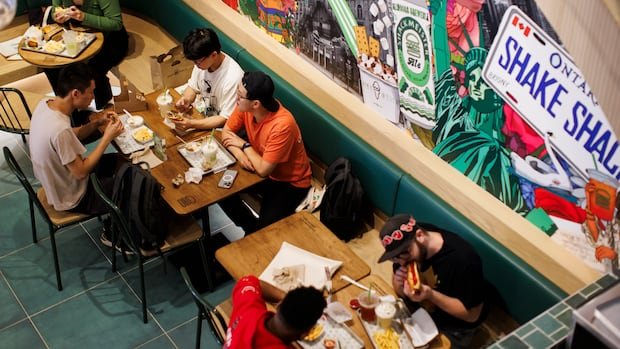
The report also reveals contrasting trends in the restaurant industry, with full-service restaurants experiencing growth in sales, while quick-service restaurants are facing a decline. Fine dining establishments have seen an increase in traffic, indicating a stronger performance in that segment of the industry.
However, challenges persist across all restaurant types, with a significant percentage reporting lower sales and profitability. Rising costs, especially in fuel prices, are expected to impact both restaurants and consumer behavior. Quick-service restaurants serve as a barometer for broader trends in the industry, indicating potential challenges for the full-service sector as well.
Food economist Mike von Massow explains that quick-service restaurants are facing intense competition, leading to strategies like value meals to attract customers. With lower-income individuals being frequent visitors to quick-service establishments, any cutbacks due to financial pressures could significantly impact this sector.
The impact extends beyond consumer choices; job opportunities, especially for young individuals, could be at risk if quick-service restaurants struggle. Von Massow emphasizes that competition from grocery stores and changing consumer habits also contribute to the challenges faced by quick-service restaurants.
On the other hand, fine dining establishments like Pearl Morissette are thriving, with a shift towards high-end dining experiences becoming the main focus for customers. Chef Daniel Hadida notes an increasing demand for upscale dining as a complete evening activity rather than a mere meal. Despite the success, restaurants like Pearl Morissette maintain fair pricing to accommodate guests, even amid rising costs.
Senecal-Junkeer faces a dilemma in balancing menu prices due to increased food costs, opting for a moderate price adjustment to maintain both volume and margins. The overall industry landscape reflects a complex interplay of economic factors influencing consumer behavior and restaurant operations.